How to bring billions in deserved benefits to 99% of Canadians
The following information is arguably 1,000 times more educational and impactful than any lecture I ever presented during my 35 years as a professor.
Over the past ten years, as a Professor Emeritus who taught The Mathematics of Finance, I have studied the Canada Pension Plan (CPP) on behalf of its 22 million contributors and beneficiaries. During this time I stumbled on disturbing details that raise serious questions about how the CPP is being managed and how its investment gains are being shared. The CPP is important. Most Canadians have contributed 10% of their lifetime earnings to the CPP, trillions of dollars.
CPP Investments outstanding performance has created roughly $500 billion in additional wealth beyond earlier projections. Yet millions of Canadians struggling with rising costs of living have seen no benefit from these gains.
If the recommendations below were implemented, millions of floundering Canadians would enjoy a considerable, deserved improvement in their quality of life. However, the overwhelming evidence indicates the selfish interests of Canada’s wealthiest 1% have been favoured over the interests of the other 99%. On this crucial issue, democracy, freedom of press and actuarial science have all been replaced with a deception that is having a profound negative impact on millions of Canadians and our sputtering economy.
The issue goes far beyond pensions. It affects:
the disposable income available to younger Canadians,
the financial security of seniors,
the strength of Canada’s economy.
Albertans’ desire to separate from Canada.
My interest in the CPP is also partly personal. The MacNaughton family has long been connected to the history of the Canada Pension Plan.
My father’s cousin, Charles MacNaughton, served as Treasurer of Ontario from 1958 to 1962. Representing Canada’s largest province at the time, he was substantially involved in the discussions that shaped the framework of the CPP in its early years.
His son, John MacNaughton—my second cousin—later played a major role in transforming how the CPP invests its funds. After the landmark pension reforms of 1997, John became the first President and CEO of the Canada Pension Plan Investment Board, now known as CPP Investments. Before those reforms, CPP contributions were invested mainly in fixed-income securities. Under his leadership, CPP Investments began investing globally in public equity, private equity, infrastructure, real estate, and more. Over the past fifteen years, this strategy has produced the strongest investment results of all the pension funds in the world.
The purpose of this website is simple: to present the evidence clearly and allow Canadians to judge for themselves.
The facts
Over the past fifteen years, CPP Investments has been one of the most successful pension fund investors in the world. As a result, the assets of the CPP have grown far beyond the levels projected in earlier actuarial reports.
In 2010, according to the Chief Actuary’s 25th Actuarial Report, the CPP fund stood at approximately $134 billion. At that time, the plan was considered fully funded under the actuarial framework, meaning that if the fund earned an average investment return of about 6% per year (the blue box below), it would be sufficient—together with future contributions—to sustain CPP benefits for the next 75 years.
The actuarial projections in that report suggested that, for long-term stability, the fund would reach about $366 billion by December 31, 2025, as shown in the red box.
However, the actual outcome has been dramatically different. According to the CPP Investments website, the fund reached $781 billion on December 31, 2025—more than double the level projected in the earlier actuarial scenario.
Another key component of the actuarial projections is Net Cash Flow—the amount remaining after contributions from working Canadians are reduced by pension payments to retirees. When estimating this figure, actuaries consider long-term demographic and economic factors including inflation, immigration, fertility rates, employment levels and mortality rates.
Over the past fifteen years, these demographic projections have been remarkably accurate restuling in a relatively minor surplus in the fund.
What has differed substantially from earlier projections is the investment performance of CPP Investments.
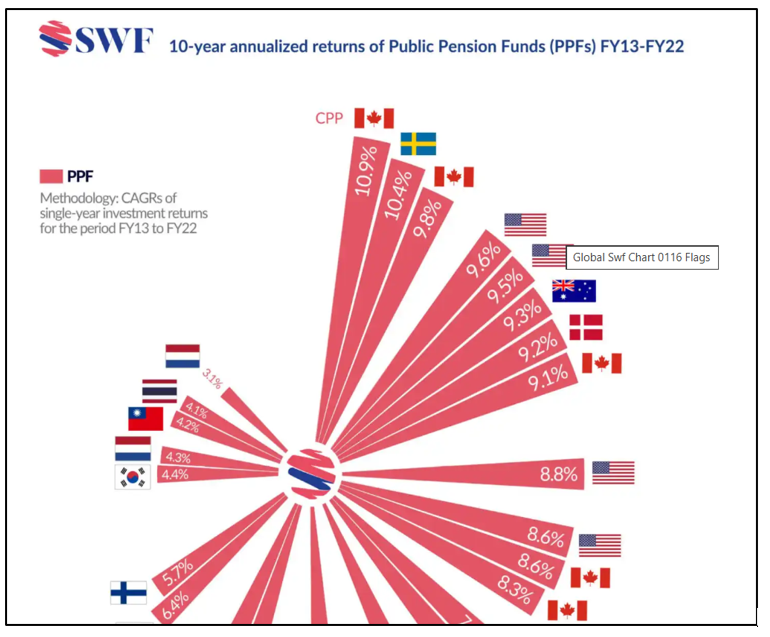
For the past fifteen years, CPP Investments has achieved an average return of roughly 10% per year. Independent pension industry research supports this strong performance. According to Global SWF, a New York–based sovereign wealth and pension fund research organization, CPP Investments ranked first among 300 major pension funds worldwide for the ten-year period ending in 2022, with an average annual return of 10.9%.
The chart below, based on Table 10 of the Chief Actuary’s 32nd Actuarial Report, illustrates how the CPP fund has grown far beyond the levels anticipated in earlier projections.
With an ongoing 10% return, the fund’s surplus will mushroom by $54 billion in 2026, $61 billion in 2027, and so on.
CPP Investments has several structural advantages that allow it to pursue higher long-term returns than many institutional investors. These include its very long investment horizon, its global diversification, and its large exposure to private markets. For example, the fund’s private equity portfolio—approximately one-third of total assets—reported a 34% return in 2022, according to the CPP Investments 2022 Annual Report on page 43.
For example, consider Ontario’s 407-ETR, a privately operated toll highway. CPP Investments owns approximately 44% of the company that operates the road, making it one of the largest shareholders.
The Pennsylvania Turnpike is frequently described as the most expensive toll road in the world. It charges roughly 20 cents USD per kilometre. In contrast, tolls on the 407-ETR can reach as high as $0.88 USD per kilometre, which is over four times higher.
Despite these higher tolls, the highway is widely used because it can significantly reduce travel time for commuters in the Greater Toronto Area. For thousands of drivers per day, the time savings outweigh the higher cost.
CPP Investments has also indicated publicly that it expects the fund to continue expanding rapidly. In a March 7, 2026 article in the Globe and Mail, they anticipate increasing the fund from roughly $780 billion in 2026 to $1 trillion by 2028. This implies an annual return of approximately 13% over those two years.
By forecasting using the return of the last 15 years, (as pension experts recommend), the amount needed to meet all CPP pension commitments becomes much less. This means our CPP fund is closer to 300% funded, with a $500 billion surplus.
To put the scale of these figures into perspective:
A $500 billion surplus means each CPP would represent roughly $23,000 per CPP contributor or pensioner.
$500 billion is comparable to about $5 trillion in the United States on a relative scale.
$500 billion is approximately 18 times Canada’s average annual federal deficit (excluding pandemic years).
$500 billion is equivalent to 36% of Canada’s total federal debt.
These figures raise an important public policy question: how should the financial gains be interpreted, and how should they ultimately benefit the Canadians whose contributions were used to create this windfall?
In most pension systems, when assets substantially exceed the amount required to meet future obligations, a portion of the excess is distributed to members. A common benchmark in pension practice is that a surplus of roughly 25% above liabilities should trigger surplus sharing.
For example, in 2000 the Ryerson University Pension Plan (now Toronto Metropolitan University) had a surplus of approximately 18%. At that time, the Canada Revenue Agency required that steps be taken to reduce the surplus, and members of the plan—including professors like myself—received distributions of up to $20,000 each.
The CRA has no jurisdiction over the CPP. Nor does our Auditor-General. Pension experts recommend every pension fund has a Board of Governors, primarily made up of contributors and pensioners. The CPP has no such Board. Our Chief Actuary has full control over 10% of the lifetime earnings of most Canadians. Yet he has never mentioned “surplus” in thousands of pages of reports on the status of the CPP. For reasons explained below, it appears he has attempted to bury a $500 billion surplus.
Consider the Public Service Alliance of Canada (PSAC). It represents approximately 245,000 members, including federal public service employees, university staff, and other public sector workers.
Our Chief Actuary also oversees the PSAC pension plan. He has stated,
“Federal rules say the plan cannot hold a surplus of more than 125% of liabilities, defining such amounts as a ‘non-permitted surplus’”.
Why would he never acknowledge the CPP’s 200% surplus but announce the PSAC’s 25% surplus as a “non-permitted surplus”? Below will explain.
A central concern in many public pension systems is intergenerational equity—ensuring that different generations of contributors and beneficiaries are treated fairly.
Since 2016, approximately one million low-income Canadian seniors have died. Many of these individuals lived on very limited incomes. If some of the CPP’s surplus, which was created using their money, was distributed to them, they could have enjoyed a longer life with higher quality. One study found that people in the highest income quintile live 13 years longer than those in the bottom quintile.
Because politicians and our Chief Actuary refuse to follow standard pension practice, many of these one million low-income seniors died earlier than they should, with a lower quality of life.
With CPP reform, 99% of Canadians would win but Canada’s financial industry would lose
Canada’s financial industry corners 47% of all corporate profit in Canada but only contributes 7.4% to our GDP. For comparison, the US financial industry only collects 25-30% of all corporate profit. Europe’s average is 20-30%.
The industry is awash in cash. In December 2025, the Globe and Mail reported that Canada’s big banks distributed $27.3 billion in bonuses. An estimated 15,000 bank employees received $1.8 million each on top of their salaries.
Meanwhile, millions of Canadians are struggling.
A recent study found that 43% of Canadians are within $200 of insolvency. On March 9, 2026, The Globe and Mail wrote that “Household debt in Canada as a percentage of GDP is 103 per cent, second-highest among 34 OECD countries.”
Another study indicates “54% of Canadians currently have credit card debt, with 72% of Millennials (ages 29-44) carrying such debt.” The credit card interest rate is roughly 20%.
Food bank usage has doubled since 2019.
Young Canadians are struggling. Greenshield research confirms this.
“TORONTO, Nov. 19, 2025 /CNW/ - A new survey from GreenShield, Canada's only national non-profit health care and insurance organization, conducted in partnership with Mental Health Research Canada (MHRC), reveals that over 80% of Canadian youth are overwhelmed by stress and anxiety about their future. Economic pressures – including job insecurity and the rising cost of living – are key drivers.”
Millions of struggling Canadians could gain huge benefits from the CPP’s surplus and potential. If they were aware that the CPP now has a $500 billion surplus and CPP Investments will likely continue investing with a 10% return, they could benefit in three ways.
Benefit # 1 - Voluntary Contributions to CPP Investments
In 2011, when CPP Investments had averaged roughly 6% annual returns for several years, then–Finance Minister Jim Flaherty examined the possibility of allowing Canadians to make voluntary investments through CPP Investments. Documents obtained through Access to Information requests indicate that the financial industry strongly opposed the idea, arguing that many Canadians might shift their savings into CPP Investments if it offered reliable returns at relatively low cost.
The power of this idea becomes clearer when we consider the effect of compound interest. Albert Einstein is often quoted as saying, “Compound interest is the eighth wonder of the world.” Whether or not he actually said it, the mathematics behind the statement is undeniable.
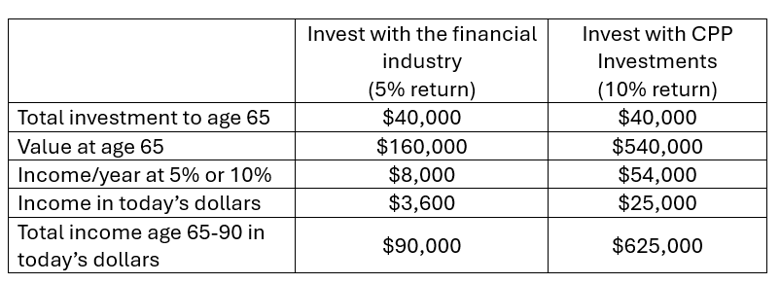
Consider a simple example. Suppose a 25-year-old Canadian voluntarily invested $1,000 per year with CPP Investments. Over forty years, the total contribution would be $40,000.
If CPP Investments continued earning approximately 10% annually, similar to its average performance over the past fifteen years, that investment would grow to roughly $540,000 by age 65.
If that amount were converted into retirement income, it could generate approximately $54,000 per year equivalent to roughly $25,000 per year in today’s purchasing power.
If the same individual invested $1,000 per year through conventional financial products earning about 5% annually, that investment would grow to only about $160,000 by age 65.
That amount would produce an annual retirement income of roughly $3,600 in today’s dollars—14% of what investing with CPP Investments might give him.
Allowing Canadians the option to invest voluntarily alongside CPP Investments could therefore provide an additional pathway for long-term retirement savings—one that benefits from the scale, diversification, and professional management of one of the world’s largest pension funds.
If Canadians were allowed to make voluntary investments through CPP Investments, many would choose this option because of the fund’s long-term investment performance and relatively low operating costs. As a result, considerable savings that currently flow into traditional wealth-management products would shift toward a publicly managed investment vehicle like CPP Investments.
Such a change could have important implications for Canada’s financial sector, particularly for wealth-management businesses that earn substantial revenues from managing individual retirement savings.
Any voluntary investment program would likely require reasonable limits. CPP Investments is designed to manage the assets of the Canada Pension Plan, and absorbing extremely large additional inflows could make it more difficult to deploy capital efficiently. For that reason, policymakers might consider placing an annual cap on voluntary contributions—for example, allowing Canadians to invest up to $1,000 per year through CPP Investments. Because $1,000 per year is below the TFSA limit, the estimated $54,000 annual income in retirement could be withdrawn tax-free.
This legislation would help neutralize Canada’s growing income inequality.
Overall, allowing voluntary contributions to CPP Investments could provide Canadians with an additional low-cost, long-term investment option while strengthening retirement savings for millions of households. However, the financial industry’s considerable profits would shrink.
Benefit #2 - Give Canadians’ CPP contributions CPP Investments’ likely 10% return
If CPP Investments continues to achieve investment returns near its long-term average of about 10%, the retirement benefits generated by Canadians’ contributions could be dramatically larger than what current projections imply.
Consider a typical example.
A 25-year-old Canadian earning $60,000 per year in 2026 dollars is required to contribute $3,362 annually to the Canada Pension Plan. His employer contributes the same amount on his behalf, bringing the total annual contribution to $6,724.
Over a working career of roughly forty years, these contributions accumulate and are intended to fund the worker’s retirement pension.
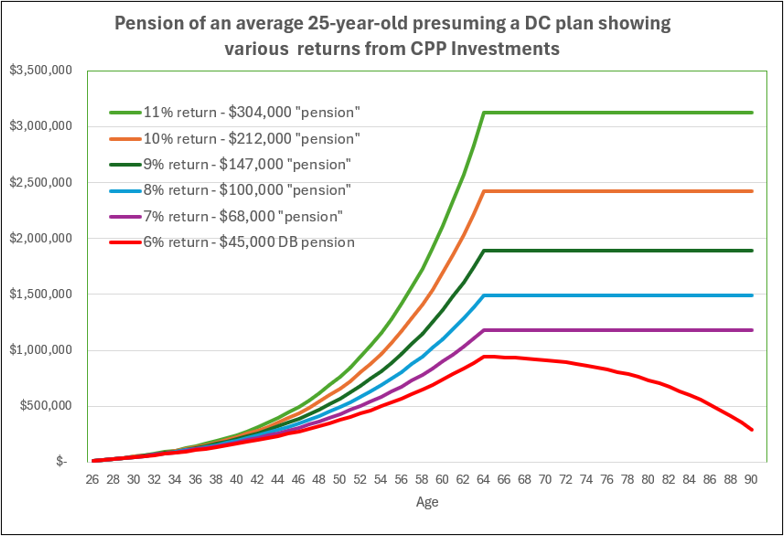
The graph below compares two scenarios:
Scenario A: Contributions effectively grow at approximately 10% per year, reflecting the long-term investment performance of CPP Investments.
Scenario B: Contributions grow at approximately 4.75%, which reflects the effective return the CPP currently gives contributors.
The difference between these two scenarios is enormous.
Key assumptions used in the analysis
A 2% annual inflation rate is assumed throughout the analysis.
A pension of $230,000 per year in forty years would therefore be equivalent to roughly $104,000 in 2026 purchasing power.
A pension of $55,000 per year in forty years would be equivalent to roughly $25,000 in 2026 purchasing power.
Life expectancy is assumed to be age 86, consistent with actuarial mortality projections.
Any remaining balance in the account at death would remain to support a possible surviving spouse, who would receive a pension equal to 60% of the partner’s pension up to the CPP maximum, consistent with current survivor benefit rules.
Conclusion
Under these assumptions, a middle-income young Canadian could receive a CPP pension equivalent to about $100,000 per year in 2026 dollars.
By comparison, the pension currently projected under existing CPP formulas is closer to $25,000 per year in today’s purchasing power.
In other words, the retirement income generated by the same contributions could be more than four times larger if contributions earned the full investment return achieved by the CPP fund.
Broader implications
If young Canadians believed that their CPP contributions could generate retirement income on this scale, it could significantly change how they plan their financial lives. Many might elect decide to:
Stop investing the recommended 15% of their income towards retirement,
Stop contributing to other pension plans (This would also eliminate a costly contribution-matching obligation for all employers.)
Stop purchasing life insurance (The CPP pays a 60% survivor pension—worth ~$60,000 per year in 2026 dollars).
The financial industry could see a reduction in revenue investment management fees, pension fund products, and life insurance sales, if more Canadians relied primarily on the Canada Pension Plan for their retirement security.
However, the financial sector could benefit in other ways. If young Canadians had as much as 15% more disposable income, many would be better positioned to save for major purchases such as a home or condominium. Increased homeownership would likely lead to greater demand for mortgages, creating additional opportunities for financial institutions to generate lending income.
If our government notified young Canadians they will likely be eligible for a $100,000 CPP pension in 2026 dollars, the improvement in their mental health might be substantial. They could be annually notified.
If the CPP became a Direct Contribution (DC) pension plan, it would be the safest, most profitable pension plan in Canada
The analysis above recommends the CPP switch from a Defined Benefit (DB) plan to a DC plan.
Under a DC pension plan, the retirement income a contributor receives depends directly on the investment performance of the funds in which their contributions are invested. If the investments perform well, the contributor benefits from higher returns. If they perform poorly, the contributor bears the risk.
Under a defined-benefit (DB) pension plan, the situation is different. Contributors are promised a specific pension benefit, typically based on factors such as salary and years of service. The investment performance of the pension fund does not directly determine the pension received by the contributor. Instead, the benefit formula implicitly reflects long-term actuarial assumptions about investment returns—often in the range of about 6% annually.
Over the past several decades, almost all private-sector pension plans in Canada have shifted away from DB plans into DC plans, transferring investment risk from employers to employees.
DC plans do involve risk: if investments perform poorly, retirement income can be significantly reduced. However, when contributions are invested through CPP Investments, the risk would be near zero and the benefits would likely result in four times the pension for young Canadians.
Benefit # 3 - The CPP’s surplus - help for millions of Canadians who need immediate assistance
Recall that 43% of Canadians are within $200 of insolvency, 54% have credit card debt and the CPP has a 200% surplus.
If our Chief Actuary followed standard pension practice and the principle of generational equity, he could, with no risk to future pensions, distribute some of the CPP’s $500 billion surplus.
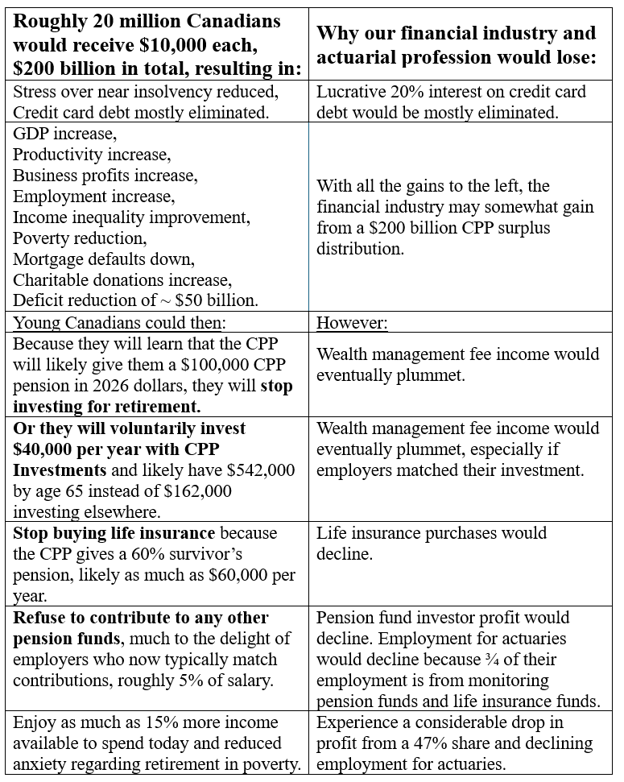
For example, a $200 billion distribution from the fund would provide roughly $10,000 on average to about 20 million Canadians.
Such a distribution could have broad economic effects. Additional income in the hands of millions of households would likely increase spending throughout the economy, potentially supporting improvements in:
economic growth
productivity
business activity and profits
employment
poverty reduction
charitable giving
Canada’s mounting deficit.
Demographic trends also highlight the economic challenges facing younger generations. Since the mid-1970s, Canada’s fertility rate has declined significantly—from about 2.1 children per woman, the level needed to sustain population growth, to roughly 1.25 today. Many researchers attribute part of this decline to the rising cost of living, housing affordability challenges, and economic uncertainty for young families.
Greater financial security for younger Canadians could influence these long-term demographic trends by improving confidence in their economic future.
At the same time, younger generations face a wide range of challenges: high housing costs, rising rents, growing income inequality, climate concerns, and increasing financial stress. Policies that strengthen retirement security and improve financial stability could help address some of these pressures.
I have emailed hundreds of journalists, economists and politicians. Not one gave a single argument against distributing the CPP’s surplus.
A summary of the pros and cons of revealing the CPP’s $500 billion surplus
Evidence showing the financial industry has orchestrated a CPP surplus cover-up
The financial industry is concerned
In 2016, when Finance Minister Bill Morneau announced underwhelming CPP changes, Janet Ecker, President of the Toronto Financial Services Alliance, expressed relief. She feared significant CPP reforms like voluntary contributions could:
"Undermine a lot of successful, legitimate, (retirement savings) products in the investment industry."
But who should be “undermined”?
Should it be an industry packed with millionaires that already captures 47% of all Canadian corporate profits?
Or should it be the millions of Canadians struggling near insolvency and needlessly investing with low returns towards retirement?
The financial industry should share more profit with non-financial industries
Some economists would suggest, “If a company earns x% of corporate profit, in an ideal world, they should contribute x% to our GDP.” With the financial industry earning 47% of all corporate profit but only contributing 7.4% to our GDP, a reduction in their profit is arguably appropriate.
While the financial industry may lose profit share, with CPP reform, other industries will gain profit share. Canadians will have much more money to spend today instead of investing for tomorrow. This means that, for Canada’s non-financial industries, sales, productivity and profit will increase, along with Canada’s anemic GDP.
Our financial industry has both the economic justification and the resources to orchestrate this widespread cover-up. Just 1% of their annual profit is $1.6 billion, equivalent to 160 “packets” of $10 million each. Consider it a business expense with a high return on investment. For example, a $1.6 billion expenditure per year today might result in a $5 billion profit flow increase per year for years to come.
Are banks, the lion’s share of the financial industry, without sin?
Banks in Canada give their customers a sense of professionalism, helpfulness and integrity. Most customers probably leave thinking “Those nice people at my bank would never abuse me.” Yet Canada’s banks have been found guilty of numerous violations, mostly related to not protecting investors.
Violation tracker is a worldwide database summarizing corporate misconduct. Below is a screen capture of a report showing the members of Canada’s financial industry that have been found guilty of financial crimes, with the size of the fine shown to the right.
For every crime committed, estimates vary regarding how many other violations never result in prosecution. Some say the ratio is 1 to 5. Others say 1 to 50. That means that, for each violation listed, there are another 5 to 50 violations taking place that are not being prosecuted.
Bank presidents work hard to satisfy shareholders with higher profits. If secretly abusing customers with no consequences, or periodic fines, will increase profit, bank presidents will sanction such abuse.
With billions of profit dollars at stake if the news of the CPP’s surplus is revealed, it is reasonable to suspect Canada’s financial industry engineered a media blackout and somehow silenced all politicians, except Premier Smith, regarding the CPP’s $500 billion surplus.
A widespread cover-up involving numerous individuals and organizations
Based on their mandate, the actuarial profession, mainstream media, the CBC, all politicians and numerous otherwise benevolent organizations should be jubilantly notifying Canadians regarding the positive benefits available from the CPP’s $500 billion surplus. And they should be harassing politicians to legislate the CPP reform that could bring immense benefits to millions of struggling Canadians. Here is evidence that shows they have all abandoned their admirable mandate.
The at-risk actuarial profession
As shown above, the financial industry has much to lose. However, they could not orchestrate such a widespread cover-up without collusion from the actuarial profession.
The actuarial profession also has much to lose. If younger Canadians learn a $100,000 CPP pension in 2026 dollars is likely, they will refuse to contribute to other pension funds. The need for other pension funds, and hence actuaries, could plummet.
Also, consider life insurance. Is it necessary? The CPP now provides surviving spouses with as much as 60% of their partner’s pension, which eventually could be as much as $60,000 per year, indexed. Using life insurance to match this benefit could cost as much as $1 million. With the CPP, it is free.
Roughly 50% of employment for actuaries is in the pension fund and life insurance business. This helps explain why the ten senior actuaries I consulted have all denied the CPP’s $500 billion surplus with evasive arguments.
One of Canada’s top actuaries is Malcolm Hamilton. In 2020, he contacted me and we debated these issues, first, in person and then via email for roughly 40 hours. He tried to silence me with vacuous arguments. Was he hired by the actuarial profession to convince me to silence my claims? Since our meeting, the CPP’s surplus has increased by another $300 billion.
One of the actuaries I consulted did have a conscience. He stated,
“Our Chief Actuary has done what pension actuaries frequently do - invent measures that are easily manipulated so that actuaries can control the narrative and hide things at will...I must remain anonymous because I am not allowed to criticize my fellow actuaries.”
As someone who has studied thousands of pages produced by our Chief Actuary, I heartily concur with this disappointing assessment of the individual who Canadians trust to safeguard our trillions of dollars in CPP contributions.
Our self-serving Chief Actuary will invoke confusing terms like sustainability, minimum contribution rate, steady-state financing, and more. The table below shows why any of these confusing terms will overcome the truth:
No matter what confusion our deceptive Chief Actuary attempts to flog, he cannot avoid the facts in the table above.
How the actuarial profession betrayed Premier Smith and all Albertans
Three years ago, I sent these details to all Premiers and their Finance Ministers. Only Premier Smith of Alberta has acted. She has demanded Alberta’s fair share of our $781 CPP fund. It is roughly $140 billion, of which $70 billion is surplus. When she receives it, her Alberta Pension Plan website states she will:
Fully match all future CPP pension obligations,
Give Alberta seniors as much as $10,000 each,
Reduce contributions by $1,425 per worker (and matching employer) annually,
Invest some of the remaining funds in Alberta’s economy.
If Alberta receives its fair share of the CPP, it is unclear if Albertans will be able to continue to invest their contributions with CPP Investments, the best pension fund investor in the world. This type of arrangement - one investor for numerous pension funds - is often done. OMERS, for example, invests contributions for 1,000 individual employers and 600,000 employees and retirees.
Nevertheless, because Albertans deserve the $70 billion in surplus benefits described above, Premier Smith has demanded Alberta’s share, even though contributions will be possibly invested with a return likely far inferior to CPP Investments probable 10% return.
In 2023, she hired Lifeworks, Canada’s largest actuarial firm, to calculate Alberta’s fair share of the fund.
The at-risk actuarial profession and financial industry knew that, if Albertans received these benefits from the CPP’s surplus, soon thereafter all Canadians would demand their fair share. Gradually, millions of Canadians might investigate and then demand the three benefits described above.
That helps explain why, while Alberta’s true share of the fund is roughly 16%, Lifeworks irresponsibly reported Alberta deserves an absurd 53% figure. And then they partnered with our mainstream media to betray Premier Smith, all Albertans and all Canadians.
Below shows how Canada’s mainstream media attributed the 53% claim to Premier Smith, portraying her as unhinged, un-Canadian and uncooperative.
Despite this ongoing disgraceful actuarial and media deception, Albertans know that, if Alberta receives its fair share of our CPP fund, they will receive as much as $10,000 each. Because Ottawa refuses to follow standard pension practice (probably to protect Toronto’s at-risk financial industry), a growing proportion of Albertans are considering separation from Canada. Town Hall Meetings confirm this. A referendum may soon decide this.
Trevor Tombe of the University of Calgary is probably Canada’s most quoted Professor of Economics. He wrote in the Globe and Mail that the idea of an Alberta Pension Plan instead of the CPP was so stupid that you could “drive a truck through the holes” in it.
After the article, I emailed him the above details and copied several of his fellow professors, notifying him that his article was depriving Albertans and Alberta of huge benefits. I told him he belonged on The Reverse Order of Canada List - a list I am compiling of those who have done the most to deprive struggling Canadians of hundreds of billions of deserved dollars.
After receiving my email, he made an about-face. At Alberta’s Town Hall Meetings, he sat beside Premier Smith, educating Albertans about the benefits of an Alberta Pension Plan.
Prime Minister Carney is the lead in this cover-up. Hopefully, he does not want to be known as the Prime Minister who let Canada split in two so that Canada’s wealthiest 1% can become wealthier at the expense of Canada’s 99%.
By March 2026, he had only given Albertans a Memorandum of Understanding and legislation that should help stimulate Alberta’s energy industry. These offerings will have little or no impact on most Albertans. However, if he declared a Canada-wide $10,000 CPP surplus payment, he could likely eliminate any impetus towards separation by Albertans.
An Alberta referendum on separation from Canada, and other issues, will take place in October 2026.
Mainstream media - refusing to publish the most impactful story in Canada in years
As shown above, Canada’s mainstream media colluded with the actuarial profession to mislead Canadians into thinking Premier Smith is unhinged as she, not Lifeworks, wants 53% of our CPP fund. This is reprehensible because Premier Smith is the only senior politician in Canada refusing to join this cover-up.
Canada’s entire mainstream media is owned by the wealthy who dictate what can be published. They give naive Canadians (like me ten years ago) the wrong impression that they are responsibly covering every topic that is newsworthy and impactful to the Canadian public. Is there a more newsworthy, impactful story than:
CPP’s $500 billion surplus can help millions of struggling Canadians
Based on standard pension practice, the CPP’s $500 billion surplus should be distributed. A no-risk $200 billion surplus distribution would give 20 million Canadians $10,000 each, on average. It would also lead to considerable improvements in Canada’s GDP, productivity, employment, business profits, poverty, income inequality, charitable donations and deficit. A recent study indicates 43% of Canadians are within $200 of insolvency. A deserved $10,000 payment would be life-changing.
Moreover, young Canadians no longer need to invest for retirement, buy life insurance or contribute to other pension plans. This is because the CPP will likely give them a $100,000 CPP pension, in 2026 dollars.
With as much as 15% more income available and news of a secure retirement, young Canadians can shed much of their current anxiety and improve their quality of life. However, the financial industry and actuarial profession would suffer.
Yet the entire mainstream media has refused to publish even the first paragraph of this reality. Two journalists who pushed the issue lost their jobs. In ten years, not once has the phrase “CPP surplus” appeared in mainstream media.
Finance Minister Chrystia Freeland should know about the media industry. At one time, she was Managing Director at Reuters, Deputy Editor at The Globe and Mail, and reported for The Financial Times, The Economist and The Washington Post. She explains why the Canadian media has published nothing on the CPP’s surplus in her book, Plutocrats: The Rise of the New Global Super-rich and the Fall of Everyone Else. The book describes how
“the super-rich have bankrolled a network of conservative think tanks, elite journals and mass media outlets to dominate the debate over economic policy.”
She implies the selfish, wealthy owners of the Canadian media are selectively publishing what is to their advantage, not what is newsworthy.
One mainstream journalist, when I suggested the wealthiest 1% are preventing news that would benefit the 99% from reaching Canadians, responded,
“I do not disagree with you at all. It was challenging working within the confines of mainstream media, and I tried to push as hard as I could to cover stories that are important to 99% of Canadians (and not the wealthy 1%) but parochial, short-term thinking and market-driven journalism often thwarted my attempts.”
It finally took a respected international publication, The Economist, to write:
“Canada’s vast pension fund is gaining even more financial clout. The fund’s portfolio size has more than tripled over the past decade and is going to become only more gigantic.”
And since those words were published in January 2019, the fund has increased by another $400 billion.
Award-winning John Miller was a Professor of Journalism at Ryerson University (now TMU) for 23 years. For 10 years he was Chair of the School of Journalism, Canada’s top-ranked journalism school. Before Ryerson, he was managing editor at The Toronto Star. He feels the current Canadian media is
“cannibalistic...They’re chewing away bone marrow of their own properties in order to make them a profit, so the whole public service aspect of journalism has sort of taken a back seat…the overall quality of journalism has been lost.”
Even “our” CBC has betrayed us
Canadians each pay roughly $40 per year for “our” CBC. In return, we understandably trust the CBC to give us the news that all privately controlled media members refuse to cover. Despite receiving repeated submissions from me, the CBC’s Senior Director of Journalistic Standards and Public Trust, CBC’s Executive Director of CBC News, and CBC’s ombudsman have responded, saying this story is not “worthy” enough and not “of great public interest.”
The CBC answers only to one individual - our Prime Minister, who has obviously told the CBC to impose a total blackout on any mention of the CPP’s surplus and potential.
Democracy Denied
All federal and provincial politicians have received these details, with a “Shame on you.” tone. Aside from Premier Smith of Alberta, none have acted.
Experts on democracy claim Canada is rife with bribery involving corporations. David Meslin, Canada's foremost expert on democracy, in his book "TEARDOWN," states,
“Our political system has evolved into a sophisticated enabler of mass institutionalized bribery... powerful corporations continue to wield enormous power in our legislatures.”
Duff Conacher of Democracywatch.ca emphasizes the significant financial impact of corporate cash, stating,
"Corporations spend $25 billion annually on their lobbying and promotion efforts."
If Canadians were aware of the above details, based on the considerable benefits described above, in a referendum, probably 99% would vote for a CPP surplus distribution. Moreover, any major federal political party could probably win a majority if they promised to give roughly 20 million Canadians $10,000 each.
The evidence is overwhelming that, on this crucial issue, instead of
“Government of the people by the people for the people”,
Canadians are receiving
“Government of the people by the financial industry for the financial industry.”
What politicians are essentially saying to 99% of Canadians.
Dear Canadians,
Thank you for your mandatory contributions to the CPP. We used your money to double what is needed to fund your pension, resulting in our CPP fund now having a 200% surplus, based on our Chief Actuary’s predictions.
All other pension funds distribute a surplus payment when the surplus is a mere 25%. However, we won’t be, even though we know most of you are struggling financially to survive.
Generational equity or fairness to all is the admirable goal of all pension fund managers. We know we are grossly ignoring this concept. Because we have ignored it, 20 million Canadians have not received a deserved $10,000 payment from the surplus. Such a surplus distribution would bring huge benefits to millions of struggling Canadians and our sputtering economy but we don’t care.
It gets worse. Since 2016, one million low-income seniors have died, never receiving their deserved $10,000. Numerous studies show that our failure to follow standard pension principles means many of these struggling seniors died earlier than they should, with a lower quality of life. That is on us but few people know because the media, controlled by the wealthy, and our CBC, controlled by us, will not report it.
We could let you know a $100,000 CPP pension in 2026 dollars is probable but then the financial industry would lose. And if you voluntarily contributed just $1,000 per year, $40,000 in total, to CPP Investments you would likely have $542,000 by age 65 whereas, with the financial industry, you would only have $161,000. The efforts made by the financial industry to suppress this wonderful news is colossal but secretive.
We don’t care. That is because such a surplus distribution would lead to our greedy financial industry eventually losing a small portion of its gigantic profits. We have decided to protect the 1% of Canadians in the financial industry, mostly millionaires, and let the remaining 99% of Canadians, most who are struggling, continue to suffer.
How do we defend ourselves? We told Professor Macnaughton that our CPP fund needs to accumulate a large surplus in case CPP Investments flounders. We know. With the fund now having $500 billion more than our Chief Actuary claimed is needed, the probability of CPP Investments floundering so badly that CPP pensions will not be paid is an estimated 0.001%.
Nevertheless, instead of distributing the surplus, we have decided to protect future CPP members by guarding against this improbable outcome. (We claim this is the reason but the real reason is massive pressure and “incentives” from the financial industry to remain silent. They are very convincing. They got all three federal parties to collude on this crucial issue. Democracy is being defied, but who cares?)
If we keep ignoring the CPP’s surplus as it mushrooms, someday Canadians will wake up and protest. Then, your grandchildren will possibly receive $1 million each in cash from the CPP’s surplus even though they only contributed a tiny fraction of that.
However, you may not have any grandchildren. Canada’s fertility rate is now half what it needs to be for a stable population. Experts claim this is because younger Canadians are so financially deprived they can’t afford to have children. The CPP’s surplus could help fix that.
Good luck with the 43% of you who are near insolvency. Food bank usage has doubled but they should still have something left for you.”
Sincerely,
Your inattentive MP
Numerous organizations with an otherwise benevolent mandate are complicit
The Canadian Association of Retired Persons, CARP, is Canada’s most influential advocate for seniors. In 2018, based on my research, their advocates asked Finance Minister Morneau to eliminate a vicious 76% clawback on low-income seniors. He listened and, in his March 2019 Budget, he eliminated the clawback. Low-income seniors now receive $440 million more per year in GIS funding. Mr. Morneau has stated, “CARP has 330,000 members and 98% vote. We listen.” CARP is the most influential advocate for seniors in Canada.
CARP’s website states,
“Time and time again our members tell us that financial security is their top concern. Pension protection is a concrete way to effect real change for seniors at no cost to taxpayers.”
Yet, despite the fact that, based on standard pension practice, seniors deserve $60 billion from the CPP’s surplus, CARP has tried very hard to suppress news of the CPP’s surplus. Recall the graphic above that showed several respected media members falsely depicting Premier Smith as unhinged. It was taken from CARP’s website.
Despite our successful partnership in eliminating a 76% clawback, CARP did not respond to me for years regarding these details about the CPP’s surplus. I even offered to debate the existence of the CPP’s surplus and potential with any actuary CARP chose, in a CARP webinar.
CARP’s failure to advocate for seniors has had devastating consequences. With a no-risk $200 billion surplus distribution, Canada’s seniors would receive roughly $60 billion in total, $10,000, on average to each of six million seniors. CARP’S 300,000 members alone would receive $3 billion. Yet, CARP has remained suspiciously silent. They are acting as if the financial industry has given them a multimillion-dollar annual donation with one condition - Never mention the CPP’s surplus and potential.
When I threatened to add CARP executives to my Reverse Order of Canada List, I finally received a response of “We never knew.” Then CARP sent me an evasive email pathetically defending their inaction. CARP would threaten a libel lawsuit for defamation if my Reverse Order of Canada List threat was based on false claims.
The influence of the financial industry must be enormous. I have sent these details to CANAGE, CFIB, Canadian Chamber of Commerce, United Way, Generation Squeeze, Democracywatch.ca, Evidence for Democracy and many more. I suspect the financial industry has accompanied their annual “donation” with a message like the following:
“Please meet your mandate and advocate strongly against any injustice you find. However, never mention the CPP’s surplus. If you do, your annual donation stops.”
When these otherwise reputable organizations never mention any existence of a cover-up, Canadians understandably conclude they are not being abused. If CARP, for example, indicates they are doing everything possible to advocate for deserved benefits for seniors, it must be true.
When otherwise reputable organizations remain silent, the job of the whistleblower becomes much more challenging.
How can such a widespread cover-up succeed?
While the evidence is overwhelming, as soon as it is suggested that hundreds of Canadians must be complicit in this cover-up, most associates become highly skeptical. How could our actuarial profession, mainstream media, CBC, all MPs, all MPPs (except Premier Smith), and numerous otherwise benevolent organizations abandon their mandate, thereby abusing 99% of Canadians, most struggling?
Here is how and why this cover-up has succeeded:
Canada’s top politicians claim manipulation by the wealthy is prevalent.
Prime Minister Carney, in his book VALUE(S), describes Canadians as victims of:
"Twisted economics, an accompanying amoral culture, and degraded institutions whose lack of accountability and integrity accelerate the system’s dysfunction."
In her book, PLUTOCRATS, Finance Minister Chrystia Freeland highlights the prevalence of elite attempts to use political influence for personal gain, stating,
“In an age of super-wealth, we need to be constantly alerted to efforts by the elite to get rich by using their political muscle to increase their share of the pre-existing pie, rather than adding value to the economy and thus increasing the size of the pie overall.”
Pierre Poilievre asserts that "Our system is broken.” and “Fire the gatekeepers.", probably alluding to our complicit Chief Actuary and the complicit President of the CBC.
In 2020, Mr. Poilievre responded to my email with the above details.
Three of Canada’s top politicians are very aware that, behind the scenes, democracy is losing out to wealthy interests. It is deeply troubling that they all ignore this opportunity to right the ship and bring huge benefits to 99% of Canadians. Even our leftwing NDP remains mute.
It appears that all three parties have agreed to remain mute. On such a crucial issue, for ten years, why has the Conservative and NDP parties never mentioned the CPP’s surplus when it could help them overcome the Liberal government’s stranglehold? The tentacles of the financial industry must be enormous but, unlike the US, under-the-radar.
One argument our MPs may have fallen for is:
“Pension fund mathematics is complex. Trust our actuaries. They advise keeping any CPP surplus for a rainy day.”
With:
trillions of Canadians’ dollars contributed,
an irrefutable $500 billion, 200% CPP surplus,
Standard pension practice giving a surplus distribution when the surplus is 25%,
Alberta possibly separating because of this issue,
The financial industry losing billions if the CPP’s surplus becomes known,
Actuarial employment halving if the CPP’s surplus becomes known,
Our Chief Actuary never audited,
Huge benefits available to 99% of Canadians,
No argument against distributing the surplus…
Politicians, our supposed watchdogs, need to step up, investigate and act, not ignore such a life changing topic for millions of struggling Canadians.
It appears our financial industry has convinced all three party leaders and their sycophantic MPs to remain silent regarding:
this no-risk substantial solution to the woes of 99% of Canadians, most who are struggling,
this solution to our anemic GDP, productivity, unemployment, income inequality and deficit problems,
our mainstream media refusing to publish the most newsworthy, impactful story in Canada in years,
our Prime Minister vetoing our trusted CBC from publishing this story,
Alberta soon possibly separating from Canada because Ottawa refuses to follow standard pension practice.
I have recently received an email from Finance Minister Freeland and an email from Kristen Underwood, Canada’s Seniors and Pensions Policy Secretariat. They each gave a pathetic defence of their inaction on such a crucial issue claiming we need to let the surplus accumulate for the influx of baby boomers retiring (already accounted for) and a downturn in investment success. However, there was no mention of “economic armageddon” or the damage a CPP surplus distribution could impose on the financial industry and actuarial profession.
It appears Canada’s party leaders and their MPs decided to drink the Kool-Aid and abandon all principles of democracy. They also ignored a giant RED FLAG.
If the financial industry has told politicians that CPP reform would be detrimental to Canadians’ overall welfare, why do Canadians not see that argument published anywhere in our media? Moreover, why has the most newsworthy, impactful story in Canada in years never been published?
On this crucial issue, Freedom of Press is non-existent, even with our CBC. Despite this RED FLAG, all our politicians remain pathetically inert.
Why would they do this? Just 1% of the financial industry’s annual profit is $1.6 billion. Please connect the dots.
MPs must obey their party leader
With a deserved $200 billion CPP surplus distribution, every MP, excluding Quebec with their QPP, would see their constituents receive roughly $750 million in total, $10,000 individually. This would lead to considerable economic stimulation for their riding and a reduction in poverty for their struggling constituents. Yet all MPs remain silent regarding this life changing topic.
However, MPs have little choice. Andrew Coyne, in his book, THE CRISIS OF CANADIAN DEMOCRACY, shows that all MPs must now follow their party leader or risk being ejected from the party, as Jane Philpott experienced because she was too ethical.
Over the last seven years, I have presented the above findings to my four MPs. They all agreed with the evidence and promised to forward the details to their party leader. That was years ago.
It is unthinkable but should be mentioned. Did all 340 MPs receive an under-the-radar bribe from the financial industry to remain silent regarding the CPP’s surplus? This would explain why all three parties refuse to even discuss the CPP’s surplus. The optics indicate this may be true. If so, MPs should be ashamed. If not, the suggestion of same may force them to finally act.
Soon, Canadians will be presented with these optics and they can judge for themselves.
Conspiracy theories are usually unfounded
In 2026, when anyone introduces a conspiracy theory, there is a knee jerk reaction to immediately reject it. This is probably because most conspiracy theories are baseless, with no concrete evidence to back them up.
The increase in sophisticated scams has also made Canadians cautious as they deal with the internet. The Delete key is often pressed even before one sentence has been read.
Meanwhile, with the CPP, the following is fact, not a theory of any sort:
The CPP holds 10% of the lifetime earnings of most Canadians.
Our CPP fund was 100% funded in 2010.
Because CPP Investments has averaged a 10% return for 15 years, our CPP fund now has a $500 billion surplus.
The CPP has a 200% surplus. When a pension fund has a 25% surplus, it should be distributed to avoid generational inequity.
A reasonable, no-risk $200 billion surplus distribution would give 20 million Canadians $10,000 each, on average, and a substantial stimulation to our anemic economy.
The CPP could be reformed to likely give young Canadians a $100,000 CPP pension in 2026 dollars. Knowing this, young Canadians would stop investing for retirement, stop buying life insurance and stop contributing to other pension plans. The financial industry would then lose billions of dollars per year.
Our Chief Actuary, who has complete control of the CPP, is in a conflict-of-interest position as revealing the CPP’s surplus would be detrimental to future employment for actuaries.
Our entire mainstream media, including our CBC, have imposed a veto on publishing the most newsworthy story in Canada in years.
Almost half of Canadians are struggling, living paycheque-to-paycheque.
Think tanks that will not reveal their funding garner undue attention
Even though think tanks will not reveal who funds them, politicians listen to think tanks. They are packed with unethical, talented, educated individuals who are paid handsomely to spread convincing misinformation that favours the wealthy. Their advocacy is based on what their concealed donors want, not what is the truth. For example, the C.D. Howe Institute recently published a paper that states
“Uncertainties lie ahead for the Canada Pension Plan that could lead to higher contribution rates or lower benefits.”
Thousands of paid, talented lobbyists can easily access naive politicians
Lobbyists are funded by private interests to convince politicians that certain policies (that are beneficial for who funds them) should be adopted. Lobbyists are all handsomely paid to forget the needs of the general public and focus only on the needs of who pays them. Using lobbyists, corporations pay billions of dollars per year to convince politicians that their recommended policy is best for all of Canada. Regrettably, near-zero lobbying is done on behalf of the less fortunate. A poverty activist or justice-seeker has little chance of accessing politicians regarding justice for them.
The official Lobby Register of Canada shows us that
Thousands of lobbyists operate in Ottawa,
They conduct tens of thousands of meetings with government officials each year,
Financial institutions, banks, insurance companies, and investment firms are among the most active sectors.
Lobbyists acting for the financial industry are responsible for the advent of RRSPs’, TFSAs and RESPs. It is a win/win. Canadians have invested $2.7 trillion in these three tax-avoidance vehicles, resulting in an annual income for the financial industry of roughly $27 billion per year. And if an investor buys a GIC with, for example, a 3% return, banks invest his GIC money in mortgages, yielding, for example, a 5.5% return and a 2.5% profit on the spread.
With RRSPs’, TFSAs and RESPs, Canadians also win because they avoid paying taxes while saving towards retirement. Or do they? Who will eventually pay the taxes that are avoided? Canadians will. While the financial industry has gained billions in profit from these vehicles, 99% of Canadians will need to replace their tax savings through other tax collection vehicles.
My MP was the principled Jane Philpott who, at the time, was an independent. Taking an ethical stance, she defied Prime Minister Trudeau’s direction to excuse SNC-Lavalin, guilty of bribery in Libya. She was then ejected from the Liberal Party. After receiving a half hour presentation from me regarding the CPP’s surplus, she stated “Disgraceful lobbyists.”
The at-risk actuarial profession has joined the cover-up
This cover-up of the CPP’s $500 billion surplus would never happen unless the actuarial profession cooperated with the financial industry. As shown earlier, if the news of the CPP’s surplus and potential becomes known, employment for actuaries would halve, because of the decline in the need for pension funds and life insurance.
Media is not delivering the truth to struggling Canadians
Despite repeated submissions from me, our entire mainstream media has never mentioned the CPP’s surplus and potential to solve the problems of 99% of Canadians. As shown above, the story of the CPP’s surplus and potential is arguably the most newsworthy story in Canada in years.
I have approached several social media companies but none will touch the topic, probably fearing repercussions from the financial industry. Finally, local media is now either owned by mainstream media, intimidated by the financial industry or, as I recently discovered, fearful of being sued.
Instead of the truth, our media has betrayed the one politician in Canada who refuses to join this cover-up, Premier Smith.
Numerous otherwise benevolent organizations have joined this cover-up
Why would numerous organizations with a mandate to help the less fortunate abandon their mandate and agree to remain silent regarding this solution to the woes of 99% of Canadians? They are all acting as if the financial industry has stated,
“Here is a generous donation to your cause. It will be ongoing as long as you never mention the CPP’s surplus.”
There is nothing illegal regarding this unwritten agreement. It is not a bribe. In the event of an investigation, participants have little to fear. However, our CRA does frown on non-profits and charitable organizations that publish a mandate, collect membership fees or donations and then ignore their mandate.
Goliath is too powerful
Hundreds of Canadians are enabling this cover-up. They suspect that, if they offend the powerful financial industry, they risk job loss (two already have), funding loss, reputation loss and more. They feel that their lone voice would have little chance of achieving success in combatting such a massive cover-up. And it would require hundreds of hours of investigation and advocacy with little chance of success.
As a retiree, I have the time, a professor’s pension, a deep concern for those two million fellow seniors living near the poverty line, and a passion for justice. This quote from The Economist summarizes the injustice.
“The marginal benefit of an extra $1,000 is greater for the poor than the rich. A hungry family might buy food for a month; a banker might blow that amount on a single dinner, not including the wine.”
Recall that 15,000 bank executives recently received a bonus payment averaging $1.8 million each while 43% of Canadians are within $200 of insolvency.
Canadians care. A nearby hospital has 920 volunteers enrolled to help, all unpaid. If only some volunteers would join the fight to combat this CPP injustice. Politicians should be bombarded Canada-wide with emails shaming them into action. The impact would be 1,000 times more helpful than volunteer work at a hospital.
If young Canadians stop investing, stock prices will decline
Most Canadians educated enough to understand these details have substantial savings invested with the financial industry. If young Canadians decide to stop investing because the CPP will eventually give them a $100,000 CPP pension in 2026 dollars, based on the law of supply and demand, stock prices will decline. This fact has probably deterred some would-be champions of CPP justice from joining the protest.
The “save-it-for-a-rainy-day” argument
Finance Minister Freeland, Kristen Underwood, Director General, Seniors and Pensions Policy Secretariat and CARP’s president have all claimed the CPP’s surplus should remain untouched in case CPP Investments ceases to invest so successfully.
This overzealous caution is absurd. It is akin to a multi-millionaire saying, “I am only spending $5 for lunch at McDonald’s because my portfolio could plummet in value.”
For the next 10 years, based on Table 10 of our Chief Actuary’s 32nd Actuarial Report, contributions to the $781 billion fund will exceed pensions. This means even if CPP Investments achieves a 0 % return for the next 10 years, our CPP fund will increase. A no-risk $200 billion CPP surplus distribution would both leave a $300 billion surplus in the fund and give 99% of Canadians huge benefits.
With authorities only providing this one flimsy reason for not distributing the surplus, Canadians should be very suspicious.
Of course, the real reason authorities refuse to discuss the CPP’s surplus - it would decrease the greedy financial industry’s profit flow, which is in the hundreds of billions of dollars. While probably all politicians know this, only Premier Smith has decided to combat it.
Rampant corruption happens in Canada
From 2011 to 2015, The Charbonneau Commission investigated corruption in the construction industry in Quebec in 2015.
It found that:
construction companies often pre-arranged who would win public contracts.
public works in Montreal were inflated by roughly 20–30%.
Engineering firms and contractors made illegal donations to political parties and used straw donors (employees reimbursed for donations).
Municipal parties were heavily implicated.
Corruption was exposed at multiple levels of government.
Problems were found in municipal governments, engineering consulting firms, construction companies and political party fundraising.
Several public officials were later charged or convicted.
Probably hundreds of Canadians were aware of this corruption. Yet, it was ongoing for 20-25 years. This CPP surplus cover-up has been ongoing for roughly 10 years.
As shown earlier, Canada’s banks, which most Canadians wrongly assess as highly ethical, have all been fined hundreds of millions of dollars for failing at investor protection.
Politicians are our referees in life. Where are you?
In my youth, I played many sports. Without a referee, it was chaos. With a referee, justice almost always prevailed and the better team won.
As we combat our struggles in life, politicians and bureaucrats are our referees. Their decisions can determine our quality of life. If they serve us well, life can be good. If not, life can be difficult.
Imagine Toronto is playing Edmonton for The Stanley Cup and referees are bribed to favour one team. If fans discovered this, the life of the referee would be in grave danger.
The overwhelming evidence above indicates our party leaders, MPs, MPPs, actuaries, media, and numerous organizations have refereed based on a bribe from the financial industry.
How you can help
As a professor, I received considerable income to work only seven months a year with the protection of tenure. Because Ryerson University matched my contributions towards my $110,000 pension, albeit indirectly, all Canadians paid for half my pension. I feel I owe Canadians and Canada. When I stumbled on this cover-up, combating it is my way of paying back.
I have spent roughly 10,000 unpaid hours trying to bring CPP justice to Canadians. If you agree with the above, on behalf of millions of struggling Canadians, hopefully you will spend a few minutes helping.
Because they were inundated with expressions of concern regarding Bill C-9, the Conservative Party participated in a prolonged filibuster. If enough Canadians similarly inundate politicians about their inaction regarding the CPP’s surplus and potential, we may finally enjoy CPP justice. On behalf of millions of struggling Canadians, I implore you to bombard our politicians with a message like this:
Dear Mr. Carney (or your MP),
Based on the website, www.fixthecpp.ca, the evidence is overwhelming that our CPP now has a $500 billion surplus which could be used to assist millions of struggling Canadians. A no-risk $200 billion CPP surplus distribution could lead to immense relief for the near-half of my fellow Canadians who are now within $200 of insolvency.
Moreover, by notifying young Canadians that a $100,000 CPP pension in 2026 dollars is likely, you could provide financial and emotional relief to Canada’s young who are struggling much more than older Canadians.
Your failure to exploit this opportunity is suspicious. I urge you to right the ship and bring these deserved benefits to Canadians.
Based on Town Hall Meetings, Albertans may separate because you refuse to treat the CPP using standard pension practice.
Sincerely,
Etc.
You may want to tone down the anger. There is no danger. I have sent more strongly worded emails to all MPs before. When one retired professor complains, it is easy to press Delete. If hundreds or thousands complain, it is not so easy.
In 2018, when I told CARP’s two female Vice-Presidents of Advocacy, a lawyer and an accountant, that two thirds of low-income seniors are women, they finally responded and acted against the 76% clawback.
Research shows that, in Canada’s financial industry:
Women only hold 30.8 % of senior management roles.
In finance and insurance, women hold about 26.7 % of board seats.
About 15–20 % of financial advisors in Canada are women.
Women earn around 82 cents for every dollar men earn,
For women under 65, they earn 78 cents for every dollar that men earn.
Probably men are predominantly orchestrating this cover-up. If you are a woman, I urge you to, like CARP’s two female advocates, stand up for women.
The only way to combat this cover-up is to notify all politicians that more and more Canadians are aware of this cover-up and their participation will be known by thousands or even millions.
Mr. Carney is the head of the snake. His email is mark.carney@parl.gc.ca. All other MPs can be found at www.ourcommons.ca/members/en/search.
Why millions of struggling Canadians are victims of what emerges as the biggest coverup in Canadian history
Based on nine years of research as a professor who taught The Mathematics of Finance, I have collected formidable evidence that indicates 99% of Canadians are victims of a coordinated, deliberate coverup—one that has deprived billions of deserved dollars from ordinary citizens so that Canada’s wealthiest 1% can become even wealthier. This coverup is so severe that it may even lead to Alberta separating from Canada.
Here is how—and why—it happened.
Canada’s CPP Surplus: The Largest Concealed Windfall in Our History
For 15 years, CPP Investments has been the top-performing pension investor in the world. Because of this unmatched investment success, our $781 billion Canada Pension Plan (CPP) fund now sits at least $500 billion above what is required to pay all CPP benefits for current and future retirees. Whose money did they use to accumulate this surplus - the 22 million contributors and pensioners who are members of the CPP.
In practical terms, 22 million Canadians have, on average, an extra $23,000 in their personal CPP account—money far beyond what is needed to fund their pensions.
The CPP’s $500 billion surplus is now an astonishing 200%. Standard pension practice is clear: At a 25% surplus, a distribution should occur.
This is exactly what happened at Ryerson University in 2000, when an 18% surplus prompted the CRA to order a surplus refund. Professors (myself included) received payments up to $20,000.
Yet the CPP—at 200% surplus—has distributed nothing.
Canadians Are Struggling While Their Money Sits Unused
A recent study found that 43% of Canadians are within $200 of insolvency. This is not a statistic—it is a national emergency.
Another study indicates “54% of Canadians currently have credit card debt, with 72% of Millennials (ages 29-44) carrying such debt.” The credit card interest rate is roughly 20%.
Food bank usage has doubled since 2019.
Meanwhile, on December 5, 2025, in an article entitled “Higher profits pushed bankers bonuses higher in 2025”, the Globe and Mail reported that Canada’s Big Six banks alone awarded $27 billion in executive bonuses—an estimated $1.8 million, on average, for 15,000 executives.
The injustice is palpable. If the CPP’s surplus had been disclosed and distributed as required, the one million low-income seniors who have died since 2016 would have received a deserved $10,000 payment. Research shows that those in the bottom quintile of income live 13 years longer than those in the top quintile. These one million struggling seniors died earlier, poorer, and with less dignity than they deserved. And another 100,000 will die this year, never receiving their deserved $10,000.
A no-risk $200-billion surplus distribution today would give 20 million Canadians $10,000 each, on average, and dramatically improve Canada’s:
GDP
Productivity
Business profits
Employment
Income inequality
Poverty
Charitable giving
The mounting deficit
Every major economic indicator would improve. So why hasn’t this happened?
Because three powerful industries would lose billions if the truth became public.
1. The Financial Industry: Protecting Billions in Profit
If Canadians understood the magnitude of the CPP’s surplus—and the CPP’s future earning power—the financial industry would face an existential threat.
Because CPP Investments has many advantages over the average investor, they are recognized as the best pension fund investor in the world. For the last 15 years, they have averaged a 10% return when only a 6% return is needed to fund all pensions.
Here is the problem facing the financial industry.
If CPP Investments continues achieving a 10% return, which is likely, the CPP can give 25-year-olds a $100,000/year CPP pension in 2025 dollars.
If young Canadians knew this, they would:
Stop investing the recommended 15% of their income towards retirement
Stop contributing to other pension plans
Stop buying life insurance, since the CPP pays a 60% survivor pension—worth ~$60,000 per year
Demand voluntary contributions to CPP Investments, a policy that Finance Minister Flaherty investigated in 2011
Enjoy as much as 15% more income and reduced financial anxiety regarding a retirement in poverty.
The industry’s lucrative business model will collapse if Canadians rely primarily on the CPP for retirement. The industry’s panic is understandable.
How wealthy is the industry? It currently captures 47% of all corporate profits in Canada but only contributes 7.5% to our anemic GDP. For comparison, in the US, the financial industry collects 25-30% of all corporate profit.
It is not just bank executives who are earning millions. Three individuals I knew from the 1970s, who joined the financial sector, now have a net worth estimated at $100 million each. Only one ever worked for a bank.
The industry is drowning in cash—and determined to protect it.
This explains why, in 2016, when Finance Minister Bill Morneau announced modest CPP changes, Janet Ecker of the Toronto Financial Services Alliance expressed relief. She feared significant CPP reforms like voluntary contributions could:
"Undermine a lot of successful, legitimate, (retirement savings) products in the investment industry."
But who should be “undermined”?
Should it be an industry that captures 47% of all Canadian corporate profits, largely for its own benefit?
Or should it be the millions of Canadians struggling to save for retirement?
2. The Actuarial Profession: Afraid of Obsolescence
If the CPP becomes the primary pension vehicle for Canadians—as it should—
the demand for other pension funds, and hence actuaries, will collapse.
Canadians have contributed roughly 10% of their lifetime earnings to the CPP (including our employer’s obligation to match on our behalf). That means, eventually, we will have each entrusted hundreds of thousands of our dollars to our Chief Actuary. Instead of being our watchdog, he has betrayed us.
Here is the entire problem in one example:
If, for example, by age 40, you had contributed $100,000 to the CPP 15 years ago, at the required 6% return, that $100,000 would be worth $218,000 today. At CPP Investments’ 10% return, that $100,000 is worth $418,000 today. That’s a $200,000 surplus in one person’s account. Actuaries should have shouted this from the rooftops. Instead, they buried it.
Of the ten top actuaries I consulted, they all denied a surplus existed—using arguments so weak they bordered on incoherent. One retired actuary, with a conscience, finally admitted:
“Our Chief Actuary has done what pension actuaries frequently do - invent measures that are easily manipulated so that actuaries can control the narrative and hide things at will...I must remain anonymous because I am not allowed to criticize my fellow actuaries.”
This is the profession tasked with safeguarding our nation’s retirement security.
3. The Mainstream Media: Silent, Complicit, Controlled
Is there a more important story in this country than:
CPP’s $500 billion surplus can help millions of struggling Canadians
Based on standard pension practice, the CPP’s $500 billion surplus should be distributed. A no-risk $200 billion surplus distribution would give 20 million Canadians $10,000 each, on average. It would also lead to considerable improvements in Canada’s GDP, productivity, employment, business profits, poverty, income inequality, charitable donations and deficit. A recent study indicates 43% of Canadians are within $200 of insolvency. A deserved $10,000 payment would be life-changing.
Moreover, young Canadians no longer need to invest for retirement, buy life insurance or contribute to other pension plans. This is because the CPP will likely give them a $100,000 CPP pension, in 2025 dollars.
With as much as 15% more income available and news of a secure retirement, young Canadians can shed much of their current anxiety and improve their quality of life. However, the financial industry and actuarial profession would suffer.
Yet the entire mainstream media has refused to publish even the first paragraph of this reality. Two journalists who pushed the issue lost their jobs. In nine years, not once has the phrase “CPP surplus” appeared in mainstream media. Nor has it appeared in thousands of pages produced by our Chief Actuary.
Most Canadians think our CBC is our vigilant watchdog. If privately owned (by the wealthy) mainstream media won’t cover a crucial story, the CBC will. However, the CBC answers only to one man: Mark Carney, who has used the CBC to impose a total blackout on the surplus.
Democracy denied
Democracy is non-existent on this pivotal issue. Any party could likely win a majority if they promised to give 20 million Canadians $10,000 each. However, almost all MPs and MPPs refuse to acknowledge the surplus, thanks to some very persuasive “influence” from our financial industry. On this crucial issue, the convincing evidence indicates that, instead of:
Government of the people by the people for the people,
Canadians are receiving
Government of the people by the financial industry for the financial industry.
Paid handsomely by the financial industry, think tank members and lobbyists have done their job. They have convinced naive politicians that revealing the CPP’s surplus and potential would lead to immense damage to the Canadian economy and individual Canadians’ overall well-being.
Just the reverse is true. Recall that a no-risk $200 billion CPP surplus distribution would give 99% of Canadians $10,000 each, relief from impending insolvency, increased employment, and roughly 10% more income (thanks to the news that the CPP will likely give them five time the CPP pension). That is not all. Economically, a $200 billion CPP surplus distribution would give Canada’s sputtering economy considerable improvements in GDP, productivity, deficit and business profits (excluding the greedy financial industry).
It was a giant red flag when the financial industry told politicians the CPP’s surplus should never be revealed to Canadians. On this crucial issue worth hundreds of billions to millions of struggling Canadians, Freedom of Press was vetoed. Moreover, even though Canadians trust our CBC to be our watchdog, they also refuse to publish the most newsworthy, most helpful story in Canada in years. And all federal politicians, even though any party could win a majority, agreed to this complete suppression of press freedom throughout Canada.
What is the sole cost of revealing the CPP’s surplus and potential—the financial industry’s profit share would descend from the current 47% to an estimated 40%, and 15,000 bank employees would no longer each enjoy a $1.9 million annual bonus.
Voluntary contributions to CPP Investments is probably the financial industry’s biggest threat. Investors would likely receive a 10% return. Meanwhile, history shows that Canadian investors have averaged a 5% return, even with the help of a financial planner or financial advisor. Over 40 years, $10,000 becomes $70,000 with a 5% return and $453,000 with a 10% return. CPP Investments would yield over seven times the profit.
If allowed, investors would stampede to voluntary contributions. With hundreds of billions of dollars added to the fund, CPP Investments would no longer be able to perform so admirably. It would be necessary, for example, to implement a $1,000 maximum contribution per Canadians per year.
A $1,000 contribution is roughly 12% of the CPP’s mandated maximum contribution. Yet, with voluntary contributions, even after accounting for inflation, a $1,000 annual contribution would give a 25-year-old a “pension” at age 65 that is 160% of what the CPP would give him.
The financial industry is understandably terrified of voluntary contributions. They know that, in 2011, when CPP Investments had only averaged a 6% return, Finance Minister Flaherty investigated voluntary contributions. Thanks to Access to Information, it can be determined that the financial industry complained that voluntary contributions would be “too complex” for the average investor. What could be simpler than contributing the suggested $1,000 maximum per year, using a payroll deduction system like the current CPP contribution system?
With voluntary contributions available, the financial industry would experience a decline in employment. Millions of Canadians have lost jobs in other industries - manufacturing, media, retail, and travel. Many more jobs have been of will soon be replaced with AI. Why should the financial industry be allowed to protect their at-risk industry especially when their protection tactics are depriving millions of Canadians of hundreds of billions in deserved benefits.
All three parties are concerned that almost half of Canadians are within $200 of insolvency. In early 2026, they unanimously passed a bill that gives an average low-income family $700 more per year in GST credits. Please compare $700 to a CPP surplus distribution that would give a typical family roughly $20,000 each, 29 times as much. Yet not one party, not one MP, will follow standard pension principles and propose a needed, deserved CPP surplus distribution.
Why This Coverup May Cause Alberta to Leave Canada
Premier Danielle Smith is the only senior politician refusing to participate in this deception. She has demanded Alberta’s fair share of the CPP: $140 billion, of which $70 billion is surplus. Using it, she plans to:
Fully match all future CPP pension obligations
Give Alberta seniors up to $10,000 each
Reduce contributions by $1,425 per worker (and matching employer) annually
Invest some of the remaining funds in Alberta’s economy.
In 2023, she hired Lifeworks to calculate Alberta’s share. They produced an absurd 53% figure—clearly designed to sabotage the case. The media then attacked her for Lifeworks’ inflated number, painting her as irrational and un-Canadian.
The above graphic is from CARP’s website. Even though CARP is seniors’ most influential advocate, CARP joined the attack, thereby depriving senior Canadians of the $60 billion that is rightfully theirs. Meanwhile two million of six million Canadian seniors barely exist near the poverty line.
Several other organizations with an admirable mandate have similarly abandoned those who they (allegedly) serve, probably because of “influence” from the wealthy financial industry. Just 1% of the industry’s annual profit is $1.6 billion, equivalent to 160 packets of $10 million of “influence” each.
Many Albertans have figured out the truth. And they are angry. Ottawa’s refusal to distribute a Canada-wide surplus or give Alberta their rightful $170 billion share of the fund may push Alberta toward separation.
Mr. Carney’s pipeline MOU does not matter when Albertans, most struggling, are each being denied their needed $10,000 surplus payment.
Capitalism - the good and the bad
Capitalism brings us good products and services at low cost. And the law of supply and demand keeps prices low. Walmart and Costco are good examples.
However, when an industry that collects 47% of all corporate profit but only contributes 7.5% to our GDP can use their billions of dollars to convince almost all politicians, our mainstream media, our CBC, the entire actuarial profession, and numerous otherwise benevolent organizations to bury the most impactful, beneficial news in years, capitalism has run amuck. When the CPP’s surplus can be used to markedly improve the lives of 99% of Canadians, and such a solution is never even discussed, politicians should be fired. Their function is to combat the selfish interests of our wealthiest 1%, not enable them.
Younger Canadians are already disadvantaged. Older Canadians have given them impossible house prices, inflated rents, high unemployment, big deficits, global warming, paying for seniors’ healthcare and OAS grants to seniors earning as much as $140,000. Moreover, in the 1970s, pensioners received 47 times their CPP contributions. Today, pensioners receive about 2.5 times their contributions.
Young Canadians now invest roughly 10% of their income towards retirement. To deceive younger Canadians into thinking they need to invest now or retire in poverty (which most believe)
of the CPP’s surplus and potential to likely give young Canadians a $100,000 CPP pension in 2026 dollars.that would lead to young Canadians ceasing to needlessly invest roughly 10% of their income towards retirement,
Progress against Goliath but more Davids are needed
With:
The financial industry,
The actuarial profession,
Mainstream media and “our” CBC,
Almost all politicians,
Lobbyists and think tanks, all funded by the wealthy,
Numerous organizations with admirable mandates,
all refusing to combat this cover-up, a great deal of advocacy and protest is needed to bring needed pension justice to millions of struggling Canadians.
By claiming Alberta deserves 53% of the fund and then attributing the claim to Premier Smith, the perpetrators of this cover-up are showing concern. They understand that, if Albertans receive these benefits, struggling Canadians in every other province will immediately demand their deserved $10,000 share. They also know that
once young Canadians realize they no longer need invest 15% of their income towards retirement,
once all Canadians realize voluntary contributions to CPP investments can give them 3.5 times the profit over 20 years,
the financial industry’s huge profit share will decline considerably.
On behalf of millions of struggling Canadians, I urge you to join the fight to overcome this disgraceful cover-up. You may want to:
demand answers from your MP,
email our Prime Minister,
contact allegedly benevolent organizations like CARP and ask them why they are ignoring their mandate,
ask our media why they are not covering the most consequential story in Canada in years,
use your own initiative and resources to shame participants into abandoning their disgraceful stance.
The Reverse Order of Canada List: Exposing Those Most Responsible
For seven years, I have contacted thousands of influential Canadians—politicians, economists, executives, journalists—urging them to expose this injustice. Almost none responded. I am disgusted and astonished that so many Canadians would actively enable a cover-up that makes Canada’s greedy 1% much wealthier at the expense of the other 99%, half of whom can barely survive.
So I created The Reverse Order of Canada List. It is a list of those who have intentionally deprived millions of Canadians of billions of deserved dollars, and more.
Suddenly, doors opened. When told they belonged near the top of the list:
Professor Trevor Tombe, a one-time writer for wealthy-funded think tanks, reversed his position after being informed he belonged near the top of the list. He now sits beside Premier Smith in Town Hall Meetings, publicly supporting an Alberta Pension Plan.
CARP finally responded after ignoring ten emails. They claim they will talk to our Minister of Finance.
CBC executives have begun investigating their blackout after being confronted and accused of denying Canadians their Charter Rights.
Kristen Underwood, Director General of Seniors Policy, issued a feeble defence that only confirmed her office’s complicity.
The List is having an impact. I am considering calling it “Canada’s version of the Epstein list.” Ruining the lives of an estimated 30 young women is disgraceful. However, depriving millions of struggling Canadians of a deserved $200 billion, and deliberately shortening the lives of one million low-income seniors is even more disgraceful.
Why the Upcoming Book Will Matter
My upcoming book on the CPP may be a bestseller because it will:
Expose what may be the largest coverup in Canadian history
Mobilize millions of Canadians to demand the surplus owed to them
Explain why Alberta is moving toward separation
Include The Reverse Order of Canada List.
This issue will not go away. The truth is out.
A Summary: How and why Canada’s 99% are being deprived of billions of deserved dollars
Impact if Canadians learn the CPP will likely give a 25-year-old a $100,000 CPP pension in today’s dollars
Proof of the CPP’s surplus
For readers seeking direct proof of the CPP’s surplus, the following will make it unmistakable. First is the Chief Actuary’s 25th Actuarial Report from 2010. Beneath it is the CPP Investments website as of December 2025. The surplus began accumulating immediately after 2010, yet every actuarial report since has used increasingly opaque methods to bury—rather than reveal—the excess. As one senior actuary admitted, the Chief Actuary has “controlled the narrative and hidden things at will.”
The three arrows above show the following:
The red arrow from the red $347B (Billion) box to the $777.5B value shows that our Chief Actuary specified he needed a $347B value on Jan. 1, 2025 and the actual value on Sept. 30, 2025 was $777.5B. This $347 billion estimate has been calculated after taking into account all factors that influence pension fund stability - investment return, employment, immigration, inflation, and mortality. Aside from investment return, our Chief Actuary’s estimate has been very accurate in predicting these factors.
The red arrow from the big box, averaging 6.1%, to the 5.4% return for the quarter, shows that, for the most recent quarter available, CPP Investments had a 21.6% return on an annual basis.
The green arrow shows the Chief Actuary specified a $22B return for the year or $5.5B for the quarter. The actual return for the quarter was $45.8B, resulting in a $40.3B surplus for the quarter and an overall surplus of $431 billion.
For perspective,
To summarize, in the three months ending September 30, 2025, our CPP fund increased by $40.3 billion more than needed. Because CPP Investments has averaged a 10% return since 2010, actuaries should forecast presuming a higher return than 6.3%. This means the fund needs a lower value than $347 billion for fund stability. The true surplus is therefore roughly 200% above target.
This single quarter’s $40 billion surplus is equal to or greater than the entire federal deficit in many ordinary years. If that much money can be hidden in a pension fund, it shows just how large the surplus really is — and how feasible a large CPP distribution would be, without “breaking the bank.”
Global SWF is a New York-based pension industry specialist. They recently analyzed all Public Pension Funds, worldwide. Below shows that CPP Investments, the best pension fund investor in the world, averaged a 10.9% return for the 10 years ending in 2022.
Because CPP data changes every quarter, only the information shown above is fully up-to-date. Any menu items above should be viewed with caution, as their figures may no longer reflect current realities.
The three arrows above show the following:
The red arrow from the red $347B box to the $777.5B value shows that our Chief Actuary specified he needed a $347B value on Jan. 1, 2025 and the actual value on Sept. 30, 2025 was $777.5B.
The red arrow from the big box, averaging 6.3%, to the 5.4% return for the quarter, is equivalent to 21.6% on annual basis.
The green arrow shows the Chief Actuary specified a $22B return for the year or $5.5B for the quarter. The actual return for the quarter was $45.8B, resulting in a $40.3B surplus for the quarter and an overall surplus of $431 billion.
For perspective,
To summarize, in the three months ending September 30, 2025, our CPP fund increased by $40.3 billion more than needed, resulting in a 124% surplus. Because CPP Investments has averaged a 10% return since 2010, actuaries forecast using a higher return, resulting in a lower needed today for fund stability. The true surplus is therefore roughly 200% above target.
he top image expected an investment return averaging roughly 6.3% per year (in the large red box). Global SWF is a New York-based pension industry specialist. They recently analyzed all Public Pension Funds, worldwide. Below shows that CPP Investments, the best pension fund investor in the world, averaged a 10.9% return for the 10 years ending in 2022.
The power of compound interest is large. For example, investing $1,000 at our Chief Actuary’s specified 6.3% return yields $1,842 in 10 years. Investing $1,000 at CPP Investments’ 10.9% return yields $2,814 in 10 years, resulting in over two times the investment return.
Who owns this $400 billion surplus? Because CPP Investments used Canadians’ money to accumulate this return, based on standard pension practice, this surplus belongs to all contributors to the CPP.
How much would you receive from a surplus distribution? It depends on how much of your contributions were used to accumulate the surplus. For example, a younger Canadian, because he has contributed less, would receive less from the surplus. Conversely, a 55-year-old Canadian in 2010, when the surplus started accumulating, may have had $100,000 in the fund. He would receive much more.
CPP Investments is proud of their outstanding ability to invest our CPP contributions with success better than any other pension fund in the world. The following graph was recently published in various Canadian media, as a paid advertisement.
The graph below shows how our CPP fund has evolved from being perfectly balanced in 2010 to a $322 billion surplus today.
By leveraging a Tax-Free Savings Account (TFSA), the $50,000 annual retirement income would be tax-free. However, inflation would reduce its future buying power to roughly $23,000 in today’s dollars. Supplementary income sources, such as Old Age Security (OAS) of approximately $9,000 per year and up to $23,000 from the CPP, would bring his total tax-free income at age 65 to roughly $50,000 annually, in 2025 dollars.
The Stark Contrast
This comparison reveals a stark difference:
Self-investing requires six times the contributions of investing through CPP Investments.
Voluntary contributions could enable Canadians to achieve the same retirement income with far less effort and financial burden.
This explains why, in 2016, when Finance Minister Bill Morneau announced modest CPP changes, Janet Ecker of the Toronto Financial Services Alliance expressed relief. She feared significant CPP reforms like voluntary contributions could:
"Undermine a lot of successful, legitimate, (retirement savings) products in the investment industry."
But who should be “undermined”?
Should it be an industry that captures 47% of all Canadian corporate profits, largely for its own benefit?
Or should it be the millions of Canadians struggling to save for retirement?
A Personal Example
Consider three university associates who joined the financial industry after graduation. Their wealth is now estimated at $100 million each. Meanwhile, ordinary Canadians are left to navigate the financial industry’s high fees and subpar returns, coupled with a pathetic, deceptive Chief Actuary to watch over our CPP contributions, 10% of our earnings, lifetime.
Could CPP Investments handle Voluntary Contributions?
If Canadians could contribute up to $1,000 annually to CPP Investments, the program would not be overwhelmed. For example, if 10 million Canadians opted for the maximum contribution, the total investment would be $10 billion per year—a manageable figure for a fund now valued at roughly $700 billion.
Moreover, the CPP currently holds a $400 billion surplus, of which $200 billion should be distributed under standard pension practices. Allowing voluntary contributions would provide CPP Investments with additional capital to offset a deserved CPP surplus distribution.
Conclusion
The financial industry cannot compete with CPP Investments’ proven track record of 10% annual returns. Voluntary contributions would give Canadians six times the value compared to traditional investment options. If made available, voluntary contributions would likely become a transformative solution for Canada’s retirement system, empowering millions while challenging the dominance of the financial sector. It would also substantially reduce skyrocketing Guaranteed Income Supplement (GIS) payments.
Canadians Deserve Better: The Case for Voluntary Contributions to CPP Investments
By coincidence, our CPP gives us the same return on our contributions as self-investing does - 4.4%. With as much as $7,500 contributed in 2025, if our contributions directly received CPP Investments’ 10% return, a 25-year-old would have a $375,000 CPP pension in 40 years, equivalent to a $169,000 pension in 2025 dollars. If we transformed the CPP into a Defined Contribution (DC) plan instead of a Defined Benefit (DB) plan, Canadians would receive six times the CPP pension.
Because of our Chief Actuary’s failure to acknowledge the CPP’s $400 billion surplus, Canadians will continue to receive a 4.4% return on their contributions. Meanwhile, CPP Investments will continue to use their contributions to achieve a 10% return.
A Hybrid Model: The Best of Both Worlds
A compromise is possible:
For example, half of contributions could be treated as DC, likely yielding a $85,000 pension (in 2025 dollars) in retirement for young Canadians.
The other half of contributions would be more than enough to meet current pension promises. They could remain in the DB system.
Younger Canadians are now struggling with anxiety and depression. As they , watch their contributions grow exponentially, they would no longer feel pressured by the financial industry’s ominous warnings:
"Invest 15% of your income for retirement—or face poverty in old age."
Instead, they could enjoy as much as 15% more income today, with greater peace of mind, anticipating a likely $85,000 CPP pension (in 2025 dollars).
The actuarial deception is ongoing. In the Fall of 2024, our Chief Actuary was asked to report her version of Alberta’s share of the fund. She refused. To further delay Alberta receiving its share of the fund, she may eventually shortchange Alberta, resulting in Premier Smith forced to consult Canada’s Supreme Court. This could take many years.
Alberta should only leave the CPP if they can still invest their share of the fund with CPP Investments, the best pension fund investor in the world. For example, the OMERS pension fund invests for 1,000 employers. For CPP Investments, subdividing the fund to represent ten provinces would be simple. Then each province could use their surplus share to help their own province. For a province to start their own investment organization would be pension suicide, as history has shown.
A much better solution would involve our likely next Prime Minister, Mr. Poilievre, legislating a Canada-wide CPP surplus distribution.
On May 3, 2024, Mr. Poilievre, stated in an article published in The National Post, entitled,
“Memo to Corporate Canada - fire your lobbyist. Ignore politicians. Go to the people.”
“Obviously, my future government will do exactly the opposite of Trudeau on almost every issue. But that does not mean that businesses will get their way. In fact, they will get nothing from me unless they convince the people first. So here is a how-to guide for dealing with a Poilievre government.
If you do have a policy proposal, don’t tell me about it. Convince Canadians that it’s good for them. Communicate your policy’s benefits directly to workers, consumers and retirees…Your communications must reach truckers, waitresses, nurses, carpenters, - all the people who are to productive to tune into the above-mentioned platforms.”
It appears the days of the lobbyist, in some cases, briber, will be over when Mr. Poilievre is elected. Time will tell. Meanwhile, encouraged by his guidance, I will send these details to common Canadians - the associations that represent workers, consumers, retirees, truckers, waitresses, nurses, carpenters and many more.
Instead of providing Alberta workers with a $10,000 lump sum surplus payment, Alberta would give all employees and contribution-matching employers a $1,425 contribution reduction each, per year.
Possibly the biggest cover-up in Canadian history
The following content has been emailed to hundreds of influential Canadians, starting in November 2023.
The consequences of the following cover-up are profound, with widespread implications for millions of Canadians and the nation as a whole. On behalf of 99% of Canadians, most of whom are currently grappling with significant challenges, I strongly encourage you to continue reading. Millions of these deprived individuals now deserve huge benefits that are not reaching them, resulting in Canada's wealthiest 1% amassing even greater wealth. It will be demonstrated that this situation involves elements of genocide.
Numerous conspiracy theories abound in today's discourse, and most are grounded in mere speculation with scant evidence. However, the theory I present here is substantiated by a wealth of proof accumulated over my seven years of research as a professor emeritus in Business. ChatGPT lists six conditions needed to validate a conspiracy theory – Evidence, Plausibility, Motivation, Expert Opinion, Critical Thinking and Media Accuracy. You will find all six conditions have been met in the following exposé.
To bolster my credibility, it is worth noting that my research and advocacy efforts played a pivotal role in securing an additional $440 million annually in Guaranteed Income Supplement (GIS) payments for low-income seniors. This accomplishment, achieved through the removal of a 76% GIS calwback rate in the March 2019 federal budget, underscores the tangible impact of my work on the lives of vulnerable individuals.
Why the Canada Pension Plan has a huge surplus.
In the current landscape marked by the challenges of COVID, inflation, high interest rates, and more, there is substantial positive news for Canadians. CPP Investments, responsible for investing 10% of the lifetime earnings of most Canadians, has proven itself to be the premier pension fund investor globally. This distinction is evident in their graph provided below from their website, showcasing their exceptional performance.
In 2010, our CPP fund was in perfect balance, able to fund all pensions for 75 years, as long as CPP Investments maintained a 6% return. Thanks to CPP Investments’ 10.9% return, our $576 billion CPP fund now has a $224 billion surplus, as illustrated in the following graph.
Following standard pension practices, approximately $170 billion of this $224 billion surplus should be distributed, posing no risk to future CPP pensions. Such a distribution would translate to $10,000 for each of 17 million Canadians, a 20% surge in business profits, a 3% increase in GDP, heightened employment rates, augmented charitable donations, diminished poverty, reduced income inequality, a $50 billion deficit reduction, and numerous other positive outcomes.
Strikingly, no politician, economist, actuary, or journalist has presented a single reason against distributing the CPP's surplus.
The CPP's surplus arguably now stands at an unprecedented 300%. In 2000, when the Ryerson University Pension Plan held a mere 18% surplus, the Canada Revenue Agency (CRA) ordered a surplus distribution, resulting in professors receiving up to $20,000 each. In contrast, our current Chief Actuary operates without oversight, answering to neither the CRA, the Auditor General, nor a Board of Governors. Despite the undisputable surplus, he has asserted, "The CPP is not in surplus!" One prominent actuary has disgustedly stated,
“Our Chief Actuary has done what pension actuaries frequently do - invent measures that are easily manipulated so that actuaries can control the narrative and hide things at will...I must remain anonymous because I am not allowed to criticize my fellow actuaries.”
My seven years of research echo these sentiments.
Future Pensions will be Enormous.
Why, then, is a distribution of the CPP’s surplus not taking place despite these numerous benefits? The financial industry, currently raking in 47% of all corporate profits in Canada, stands to lose billions of dollars if Canadians become aware of the CPP’s substantial surplus and likely ongoing 10.9% return. The industry is very aware that, if CPP Investments maintains its impressive 10.9% return rate, a 25-year-old earning, for example, $50,000 today could likely enjoy a $200,000 CPP pension in 2023 dollars, as the graph below shows.
A 10.9% return over 40 years more than triples the value of this personal fund to $4.5 million instead of $1.3 million, the value in 40 years, using a 6% return.
This analysis presumes a 2% inflation rate. This means, at age 65, the $4.5 million fund value is equivalent to $2.034 million in 2023 dollars. This value results in a $200,000 pension, in 2023 dollars, presuming an ongoing 10.9% return.
Because the CPP is a pay-as-you-go pension plan, roughly half of one’s contributions must be used to pay pensioners, resulting in a $100,000 CPP pension, in 2023 dollars, for all 25-year-olds currently earning $50,000 per year.
The CPP now promises young Canadians a pension that is 33% of their working income. This analysis shows they can anticipate a pension that is 200% of their working income. As CPP Investments reports its results annually, this expectation can adjust up or down. However, in 13 years of surplus results, our deceitful Chief Actuary has never stated the word “surplus” in any of his thousands of pages of reports. A Board of Governors, primarily composed of non-actuaries, needs to mandate informative reporting requirements, not the confusing, deceptive garbage we currently receive. He is supposed to serve Canadians, not deceive them.
For CPP Investments, ongoing high returns are probable. For example, their private equity investments, constituting one-third of their entire portfolio, recently achieved an unprecedented 33.2% return, as shown in their Annual Report 2022 (Page 43). CPP Investments enjoys many investment advantages over the individual investor.
Why the Financial Industry would Lose.
The financial industry recommends we all invest 15% of our income towards retirement. For example, Canadians now have $4 trillion invested in RRSPs and TFSAs alone. However, this practice would almost vanish if Canadians discovered the prospect of a likely $200,000 CPP pension. The financial industry would then lose billions of dollars in investment fees, annually.
The surge in mental health issues among Canada's youth is a growing concern. The revelation that a $200,000 CPP pension awaits them, coupled with 15% more income available to improve their current quality of life, could bring peace of mind to millions of young, struggling Canadians. For some, it could even pave the way for a down payment on a home.
Furthermore, this projected 15% increase in income stands to not only elevate income tax and HST collections but also bolster business profits. This collective impact could contribute significantly to alleviating our burgeoning deficit and revitalizing our sluggish GDP.
Currently, businesses in the private sector, to attract competent employees, are contributing as much as $10,000 per employee per year towards their pensions. The revelation of CPP Investments' capability to yield a $200,000 CPP pension in 2023 dollars could potentially render this considerable pension expense obsolete.
There is also financial industry concern that politicians would allow voluntary contributions to CPP Investments. Such a scenario could prompt an immediate shift of billions of investment dollars from the financial industry to CPP Investments, recognized as the world's premier pension fund investor. This prospect was explored by Finance Minister Flaherty in 2011. The financial industry has publicly stated CPP legislation could,
“Undermine a lot of successful, legitimate, (retirement savings) products in the investment industry.”
Who should be undermined? - Millions of struggling Canadians or an industry that now corners 47% of all corporate profits.
The financial industry manages an impressive $10 trillion in assets in Canada, with the big six Canadian banks overseeing a substantial 70% of this total, equivalent to $7 trillion. Despite projecting a pristine and caring image through annual donations of roughly $100 million per year to charities, compelling evidence suggests that behind the scenes, they endorsed this cover-up. Clearly, they possess the power and influence to put an end to it. If they don’t, is it plausible that irate Canadians might consider redirecting their banking needs to smaller banks or credit unions in the near future?
In addition to the escalating challenges in mental health, older Canadians have passed on to their children formidable issues such as soaring house prices, inflated rental costs, increasing income inequality, a demanding work environment, perilous climate change, and a global landscape marred by dictatorships, injustice, and frequent wars. We have a debt to repay to them. Appropriate CPP legislation would mark a substantial step forward. Continuing to allow this disgraceful cover-up to continue would be a substantial step backward.
Could the financial industry subtly be utilizing its substantial profits to suppress information about the CPP's surplus reaching the public? The industry possesses both the motivation and the resources to orchestrate such a cover-up. For instance, allocating just 0.8% of the industry's annual $125 billion profit amounts to a significant $1 billion, or $1,000 million. It raises the question: Why would the industry not invest $1 billion to safeguard a continued flow of billions of dollars in profit, per year? The evidence strongly suggests that they have bribed:
Politicians to refrain from mentioning the CPP's surplus,
The media to avoid discussing the CPP's surplus,
Actuaries to steer clear of acknowledging the CPP's surplus.
Several Experts and Icons Recommend Suspicion and Vigilance
they can construct a convoluted web of deception capable of destroying democracy. To counteract this cover-up, the collective action of many thousands of Canadians is imperative. Only then, with the specter of exposure looming, will these three complicit industries backpedal and abandon their deceitful efforts.
Our CPP fund will continue to mushroom in size. In January 2019, The Economist wrote,
“The CPP fund’s portfolio size has more than tripled over the past decade and is going to become only more gigantic.”
And since this article was published, our CPP fund has increased by another $176 billion to $536 billion in 2023.
However, the evidence is overwhelming that three powerful industries have colluded to keep 99% of Canadians in the dark regarding the CPP’s gigantic surplus. The Actuarial industry, the Finance industry and the Media industry could lose billions of dollars if politicians legislated appropriate CPP reform, which 99% of Canadians would endorse. This means millions of Canadians and Canada are being deprived of billions of dollars of deserved benefits.
Based on standard pension protocol, the CPP should safely distribute $170 billion of its $224 billion surplus. This would probably inject $100 billion into our sputtering economy, thereby:
giving $10,000, on average, to each of 17 million Canadians,
increasing our GDP by 4%,
creating 150,000 jobs,
increasing business profits by 20%,
reducing poverty,
increasing charitable donations this year by an estimated 10%.
Moreover, a $170 billion CPP surplus distribution would decrease our deficit by roughly $50 billion through increased income tax, increased HST and decreased spending on social programs.
Also, the CPP could easily help solve mushrooming income inequality, if we invested every contributor’s first $2,000 in annual contributions directly with CPP Investments. Every working Canadian would then enjoy a likely 11% annual return on these contributions, instead of what the CPP now gives them, a 4.4% return.
With this policy, almost all 25-year-olds, for example, would have $1.2 million more in their personal CPP account by age 65. They could retire with a $60,000 pension increase, in 2023 dollars. This is 20 times what the CPP now promises them for their first $2,000 in contributions.
Young Canadians are told by the financial industry to invest 15% of their earnings for retirement. Many other young Canadians are scrimping and saving for a down payment on a home. In a recent poll, “three in ten (28%) currently working Canadians say they never expect to retire.” Knowing they would be $1.2 million wealthier at age 65, many might stop saving for both retirement and a home. This means their anxiety level would decrease and their lifestyle would increase with 10% more income available for day-to-day expenses.
However, such legislation would cost the financial industry many billions of dollars in lost investment fee revenue and mortgage revenue. This potential loss provides the financial considerable motivation to conceal the CPP’s surplus and potential.
Two million of six million seniors now live near the poverty line of $21,000 per year. With this policy, this tragedy could be mostly eliminated in 40 years.
Not just 25-year-old Canadians would benefit with this policy. Older Canadians would also benefit. For example, almost all 45-year-olds would have $100,000 more in their personal CPP account by age 65.
Almost all Canadians businesses would also benefit from a $170 billion CPP surplus distribution. If, for example, Canadian consumers spent $100 billion of their $170 billion windfall gain, business profits would increase by an estimated 20% . This is because initial revenue pays fixed expenses. After fixed expenses have been paid, the gross margin of all additional revenue is pure profit.
There would be near-zero risk with a surplus distribution. Firstly, a $54 billion surplus would remain in the fund. Secondly, because CPP Investments is probably the best pension fund investor in the world, this gigantic surplus will keep mushrooming. For example, CPP Investments’ private equity investments, 1/3 of their entire portfolio, recently had an unheard-of 33.2% return for one year.
Looking forward, consider 2023. Our Chief Actuary specified he needs a $20 billion return from CPP Investments for fund stability. Based on past results, the actual return will likely be $59 billion, adding another $39 billion to the $224 billion surplus.
In the history of Canada, has there ever been a policy that could bring so many huge benefits to Canadians and Canada? Curiously, no politician, journalist, economist, or actuary has provided one reason to NOT distribute the CPP’s surplus. Hundreds have been consulted.
Why? It is probably because our capitalist system is, under-the-radar, rigged to favour the super-rich. Below, you will find several statements from respected authorities who claim our capitalist system is seriously flawed such that low-income Canadians are being unfairly abused. For example, Chrystia Freeland, in her book, PLUTOCRATS, states:
“In an age of super-wealth, we need to be constantly alerted to efforts by the elite to get rich by using their political muscle to increase their share of the pre-existing pie, rather than by adding value to the economy and thus increasing the size of the pie overall.”
Mark Carney, at one time Governor of the Bank of Canada, in his book, VALUES states citizens are victims of:
“Twisted economics, an accompanying amoral culture, and degraded institutions whose lack of accountability and integrity accelerate the system’s dysfunction.”
For example, in the 1960’s, the top marginal tax rate was 81% for the wealthy, Now it is roughly 53%. Were politicians illegally paid by the wealthy to lower it, resulting in poorer Canadians paying more taxes?
David Meslin is arguably Canada’s foremost expert on democracy. In his book, TEARDOWN, he states:
“To put it more bluntly, our political system has evolved into a sophisticated enabler of mass institutionalized bribery.”
Duff Conacher, on his website, Democracywatch.ca, states:
“Canada’s biggest corporations spend $25 billion annually on their lobbying and promotion efforts.”
Jane Philpott, after viewing a half hour presentation on the CPP’s surplus, stated:
“This failure to legislate CPP reform for both Canadians and Canada is caused by disgraceful lobbyists.”
Pierre Poilievre, likely Canada’s next prime minister, has stated:
“Our system is broken.”
“Defund the CBC.”
“Fire the gatekeepers.”
Two of the gatekeepers that Mr. Poilievre is likely alluding to are:
Our deceptive Chief Actuary who has misled Canadians on the true status of the CPP to protect his at-risk actuarial industry.
Catherine Tait, President of the CBC, who refuses to tell Canadians about the CPP’s irrefutable $224 billion surplus, probably based on direction from Mr. Trudeau and/or the financial industry.
The email below shows that Mr. Poilievre is aware of the CPP’s surplus and may soon propose CPP legislation to bring these huge benefits to Canadians and Canada.
In 2000, when the Ryerson University Pension Plan had a mere 18% surplus, the CRA ordered a surplus distribution. Professors, including me, received as much as $20,000 each. The graph below shows how much bigger the CPP’s surplus is, compared to Ryerson’s surplus, on a percentage basis.
nancial industry earns a massive 47% of all Canadian corporate profits, $125 billion per year. However, they only contribute 7.5% to Canada’s GDP. Many millionaires in the financial industry would lose if the news of the CPP’s surplus became known. In the US, the financial industry only earns 14.8% of all corporate profits.
There are 40,000 Certified Financial Analysts (CFAs) and Certified Financial Planners (CFPs) in Canada. I personally know two who are probably now worth $100 million.
Why? In 2011, Finance Minister Flaherty investigated the possibility of voluntary contributions to CPP Investments. By voluntarily investing with CPP Investments, investors like you and I could probably earn three times the profit over ten years, at much lower risk. If voluntary contributions were allowed, millions of profit-seeking Canadians would quickly transfer billions of investment dollars from the financial industry to CPP Investments. Lucrative investment fee revenue for the financial industry would then plummet.
The industry’s representative, Janet Ecker stated that her industry is worried that revised CPP policy could
“undermine a lot of successful, legitimate (retirement savings) products in the investment industry”.
Who should be undermined? Should it be millions of struggling Canadians, or the already obscenely profitable financial industry?
Are the media and our politicians focussed on the wrong issue?
Grocery store prices have recently risen substantially, laregly because of COVID. In early 2023, the media covered this increase thoroughly with a tone alleging gouging by grocery store executives. In March 2023, politicians, hearing of Canadians struggling with increased food prices, decided to grill grocery store executives. The executives defended themselves adequately, claiming they were simply passing on increased prices from suppliers.
As the graph below shows, the financial industry earns over 12 times the profit of the grocery industry, roughly $125 billion per year versus $10 billion per year. Why has the Canadian media never published one word regarding an industry that corners almost half of all corporate profit in Canada?
The blue bars on the graph show each industry’s contribution to our GDP, which is now anemic compared to other OECD countries. A reasonable guideline suggests, if an industry contributes X% to our GDP, it should enjoy X% of total Canadian profits. The graph shows that the financial industry has defied this guideline by a factor of 6.4, leaving little profit for all other industries.
For perspective, the graph also shows that the financial industry in the US only earns 14.8% of all corporate profits in the US.
Summary:
Any party could likely win a majority by promising to give 17 million Canadians $10,000 each, and much more. Only a substantial all-party bribe would keep all three parties silent.
One expert on democracy in Canada claims “our political system has evolved into a sophisticated enabler of mass institutionalized bribery.” Another claims $25 billion per year is spent on lobbying and promotion.
Just 0.1% of the financial industry’s $125 Billion annual profit is $125 Million. This is roughly double what all three political parties, combined, receive per year from legal contributions. A $125 million “incentive” would be very attractive if the only condition was “Never discuss the CPP’s surplus and potential”. Knowing that the actuarial industry and the media industry are complicit makes the bribe even more attractive and more undetectable.
Political parties need money. The lucrative pay-per-vote subsidy was eliminated in 2015. It gave the three parties $25 million each, on average, per election. It is difficult to comprehend how political parties have survived, based on the funding they receive legally.
Media experts maintain our Canadian media has sacrificed journalistic integrity for profit. For example, a second $125 million “donation” from the financial industry to never cover the CPP’s surplus would cost a mere 0.1% of their annual profit. Meanwhile, said $125 million would be very convincing if the only condition was “Do not cover certain topics, including the CPP’s surplus.”
Companies typically spend well over 10% of their profit on marketing and promotion. For the financial industry, investing a mere 0.2% of profit to bribe politicians and the media to remain silent regarding the CPP’s surplus is an excellent investment – spend $250 million to preserve a profit that is 500 times that much.
There is little danger of being detected. The bribes are probably well hidden. There is probably no written documentation that summarizes the bribe agreement. (Complicit think tank C. D. Howe Institute’s website boasts 90 clandestine meetings a year that are “off-the-record”.) And no evidence would ever lead to the executives of the big Canadian banks. They oversee 70% of the $10 trillion financial industry and have the power and influence to stop this CPP surplus cover-up.
Only a full-scale inquiry, with subpoenas demanding honest testimony or jail, might bring truth. And, because all three parties are complicit, which party would call for such an inquiry?
Democracy in Canada is being denied. Probably 99% of Canadians would vote for the CPP reform and benefits described above. Meanwhile, in an ideal democracy, the wishes of 51% of the population become legislation. This denial is increasing the wealth of the super-rich while depriving the less fortunate of billions of deserved dollars.
There are thousands of well-paid, secretive lobbyists in Canada. Why would politicians listen to lobbyists? Aside from cash, lobbyists have little power to sway politicians. Most politicians would reasonably respond, “If I do as you suggest to help your industry, I would be helping 1% of Canadians but hurting the other 99%. I would lose votes in the next election. Have you got anything more convincing than just suggestions?”
What politician would blow the whistle? Ethical Cabinet Ministers Jane Philpott and Jodie Wilson-Raybould refused to “play the game” and endorse the Liberal Party’s unethical shortcomings. Their influence in Canadian politics has now plummeted to near-zero.
How can Canadians combat this cover-up?
If enough Canadians participate, we can make the perpetrators yield and bring the above benefits to Canadians and Canada. The following actions will help you gather further proof that a cover-up is ongoing. First, it will give all the culprits an opportunity to explain their actions. Then, if no explanation is forthcoming, we can soundly punish the participants with our collective actions.
For example, we can;
Email our MP, asking him to explain why his party has not proposed a CPP surplus distribution. When none is supplied (as I have experienced several times), tell him you will vote for any party but his in the next election. Party leaders will take note. For a party to win an election, almost all incumbents must get re-elected.
Email all six bank presidents, asking for an explanation of why they are not lobbying for a CPP surplus distribution. If none is supplied, tell your bank or all banks that you will be switching to a credit union.
Email Rogers and Bell who control much of the Canadian media. Ask them for an explanation of why their media outlets are not covering the CPP’s surplus. If none is supplied, tell them you will be switching to Telus for your cellphone service.
Email the Canadian Chamber of Commerce, asking them why they are not lobbying for CPP reform. It would give all their business members, except the financial industry, a 20% increase in profit. Remind them that their inaction is also costing you, an employee, $10,000. Copy your employer and suggest he cancel his membership to the Chamber.
Email The Toronto Star, The Globe and Mail, and any other publication, asking why they are not covering the CPP’s surplus. Notify them that, if no explanation is forthcoming, you will cancel your subscription.
Ask our Chief Actuary why he has denied a CPP surplus, thereby selfishly depriving Canadians of a deserved $170 billion. Also, ask why he is not governed by a Board of Governors. Without an explanation, tell him you will vote for Mr. Poilievre who wants to “Fire the gatekeepers.”
For your convenience, Demand Action contains all email addresses and sample emails for you to copy and paste into your email product. There is no danger. You are simply a citizen exercising your right to freedom of speech who is reasonably asking for an explanation. Then you are exercising your right to use the services of any politician or company that you feel is concerned about your welfare, not ignoring it.